Published by Legal Balkan Immigration & Cross-Border Nationality Practice | Verified Under Law No. 10/L-023 (in force since 21 May 2026)
Acquiring Kosovo citizenship by descent provides international applicants, diaspora families, and cross-border investors with a strategic legal gateway to Southeastern Europe. Characterized by one of the youngest populations, lowest operational cost structures, and most agile commercial frameworks on the European continent, the Republic of Kosovo offers significant geopolitical advantages. Notably, with the formal implementation of visa-free travel across the European Schengen Area, holders of the biometric passport of the Republic of Kosovo enjoy visa-free mobility for 90 days within any 180-day period across all 27 Schengen member states. In tandem with Kosovo's institutional trajectory toward European integration under the European Commission Enlargement Framework, obtaining Kosovo citizenship confers lasting personal, financial, and generational mobility.
The acquisition, loss and reacquisition of citizenship in the Republic of Kosovo are governed by Law No. 10/L-023 on Citizenship of the Republic of Kosovo (Ligji Nr. 10/L-023 për Shtetësinë e Republikës së Kosovës), adopted by the Assembly on 23 April 2026, published in the Official Gazette No. 7/2026 on 6 May 2026 and in force since 21 May 2026. The new law repealed the previous Law No. 04/L-215 on Citizenship of Kosovo (2013). Citizenship proceedings are handled by the Ministry of Internal Affairs of the Republic of Kosovo (Ministria e Punëve të Brendshme - MPB), working with the Civil Registration Agency (Agjencia e Regjistrimit Civil - ARC).
For the extensive global Kosovo diaspora—distributed throughout Germany, Switzerland, Austria, Türkiye, the United States, and Western Europe—Kosovo's legal regime offers two important routes: the diaspora provision of Article 15 and the 1 January 1998 registration right of Article 31. This guide outlines the statutory provisions, archival research methodology, evidentiary thresholds, and administrative steps necessary to obtain Kosovo citizenship in 2026.
Table of Contents
Kosovo Citizenship at a Glance (2026)
- By descent: a child is a Kosovo citizen at birth if at least one parent is a Kosovo citizen (Article 6); children born abroad must be registered before the age of 18 to obtain Kosovo citizenship by descent.
- Diaspora route: persons born in Kosovo who live abroad and keep close family or economic ties, and their direct descendants with such ties, can acquire Kosovo citizenship under Article 15 without the age, residence and language conditions of Article 10.
- Naturalization: five years of uninterrupted residence after obtaining a permanent residence permit, integration, sufficient means, no outstanding obligations to the state and basic literacy in Albanian or Serbian (Article 10).
- Marriage: three years of marriage to a Kosovo citizen and at least one year of regular residence in Kosovo on a valid residence permit (Article 12).
- Dual citizenship: Article 4 allows Kosovo citizenship to be held alongside other nationalities.
- Processing time: the Ministry must decide on a Kosovo citizenship application within 180 days (Article 24).
1. The Constitutional & Statutory Architecture of Kosovo Citizenship
The citizenship legislation of the Republic of Kosovo is anchored in Article 155 of the Constitution of the Republic of Kosovo, which provides that citizenship is regulated by law. Law No. 10/L-023 establishes a transparent, non-discriminatory statutory framework designed to prevent statelessness and protect diaspora rights.
Under Article 5 of Law No. 10/L-023, Kosovo citizenship is acquired on the following legal grounds:
- Birth on the Basis of Origin (Fitimi i shtetësisë me lindje në bazë të origjinës – Article 6): the lineage route based on a parent who is a Kosovo citizen.
- Adoption (Fitimi i shtetësisë me adoptim – Article 8): a child adopted by at least one Kosovo citizen acquires citizenship.
- Naturalization (Fitimi i shtetësisë me natyralizim – Articles 9–16): standard residence naturalization, special interest, spouses, children of naturalized citizens, refugees and stateless persons, members of the diaspora and reacquisition after release.
- International Agreements and Registration under Articles 30–31: persons registered as permanent residents under UNMIK Regulation No. 2000/13, and former FRY citizens who were permanent residents of Kosovo on 1 January 1998 and their direct descendants. Children born or found in Kosovo whose parents are unknown or stateless acquire citizenship by birth on the territory (Article 7).
Statutory Right to Multiple Citizenships (Article 4):
"A citizen of the Republic of Kosovo may also hold the citizenship of one or more other states. The acquisition and holding of another citizenship does not result in the loss of the citizenship of the Republic of Kosovo."
Under Article 4, foreign citizens acquiring Kosovo citizenship are not required to renounce their original citizenship, and acquiring another citizenship never causes the loss of Kosovo citizenship.
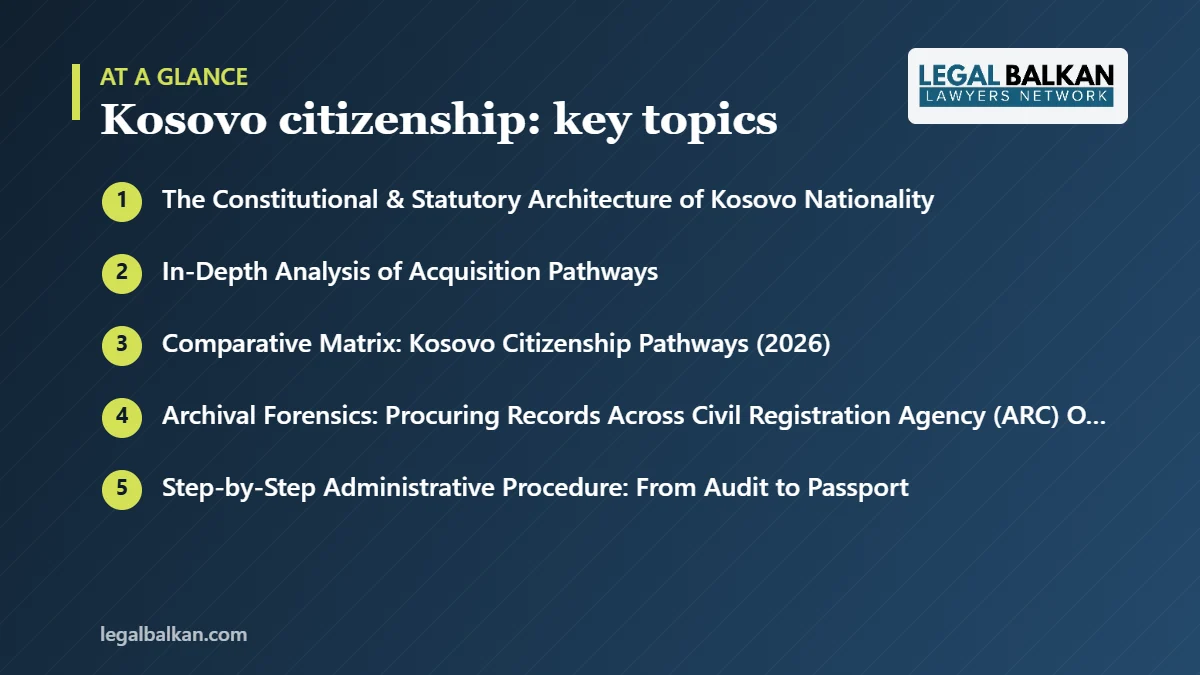
2. Five Pathways to Kosovo Citizenship
Pathway A: Kosovo Citizenship by Origin (Jus Sanguinis – Article 6)
Acquisition by origin represents the most direct statutory avenue to nationality for children born to Kosovo citizens. The law distinguishes between several practical scenarios:
1. At Least One Parent Is a Kosovo Citizen (Article 6(1)–(2))
A child is born a citizen of the Republic of Kosovo if at least one parent is a Kosovo citizen at the moment of birth, regardless of where the child is born. A child also has the right to be registered as a citizen if, at the moment of birth, at least one parent held a permanent resident document acquired on the basis of origin.
2. Child Born Abroad with a Parent of Another Citizenship (Article 6(3)–(4))
If the child is born outside Kosovo and one parent has a different citizenship, both parents must agree in writing that the child acquires Kosovo citizenship; children aged 14 to 18 must also give their own consent. Without this consent the child still acquires Kosovo citizenship if he or she would otherwise be stateless.
3. Registration Deadlines for Children Born Abroad (Article 6(5)–(7))
Children born abroad who qualify under Article 6 must exercise their right to be registered as Kosovo citizens within these limits:
- Before reaching the age of 18 (Article 6(5)).
- Until the age of 23 only where the person would otherwise remain stateless (Article 6(6)).
- These rules do not apply to children born before their parents acquired Kosovo citizenship or permanent resident status (Article 6(7)); such cases should be assessed under Article 13 (children of naturalized citizens) or the diaspora route.
Pathway B: The Diaspora Route (Article 15) and the 1998 Registration Right (Article 31)
Law No. 10/L-023 contains two separate routes for people with roots in Kosovo who live abroad. They are often confused, but their conditions are different.
Article 15: Naturalization of Members of the Kosovo Diaspora
A member of the diaspora is any person with lawful residence outside Kosovo who proves that he or she was born in Kosovo and has close family or economic ties with Kosovo. A direct descendant of such a person is also treated as a member of the diaspora if he or she proves close family or economic ties with Kosovo. Diaspora members acquire Kosovo citizenship on request without the age, five-year residence and language conditions of Article 10(1). The criteria for close family or economic ties are set by a sub-legal act of the Minister of Internal Affairs.
Article 31: Registration of Persons Resident in Kosovo on 1 January 1998
- Right to Kosovo citizenship: Article 31 recognises the right to Kosovo citizenship, regardless of current residence and citizenship, of all citizens of the former Federal Republic of Yugoslavia who were permanent residents of Kosovo on 1 January 1998, and of their direct descendants.
- Registration on request: registration in the register of citizens is made on the person's own request; the evidence of FRY citizenship and of permanent residence in Kosovo on 1 January 1998 is defined by a sub-legal act of the Ministry of Internal Affairs.
- UNMIK registrations: persons registered as permanent residents under UNMIK Regulation No. 2000/13 on the Central Civil Registry are already considered Kosovo citizens under Article 30.
- Dual citizenship: protected under Article 4 for both routes.
Pathway C: Standard Naturalization by Lawful Residence (Article 10)
Foreign citizens who lack ancestral or ethnic ties to Kosovo can apply for citizenship under general naturalization provisions by fulfilling the following cumulative statutory conditions:
- Age: must be an adult (18 or older).
- Five-Year Residence: must have resided in Kosovo without interruption for at least five (5) years after obtaining a permanent residence permit. Absences of up to ten months do not interrupt residence; longer absences require the Ministry's approval. In exceptional circumstances the period is two years.
- Language and Integration: must prove integration through social, cultural, scientific, economic or professional ties and show elementary reading and writing skills in one of the official languages (Albanian or Serbian) plus basic knowledge of Kosovo's culture and social order. Native speakers of an official language and persons over 65 are exempt.
- Financial Self-Sufficiency: must have sufficient means to support themselves and their dependants without social assistance, and must have settled all financial obligations to the state.
- Clean Record and Declaration: must sign a written declaration accepting the constitutional and legal order of Kosovo and must not have a final criminal conviction (fines and sentences of up to one year are disregarded), nor pose a risk to Kosovo's security or international relations (Article 9).
Pathway D: Facilitated Naturalization by Marriage (Article 12)
Foreign nationals married to Kosovo citizens benefit from expedited naturalization terms under Article 12:
- The marriage to a Kosovo citizen must have lasted at least three (3) years; if the spouse is a naturalized citizen, three years must have passed since his or her naturalization.
- The foreign spouse must have lived regularly in Kosovo for at least one (1) year with a valid residence permit.
- The other conditions of Article 10(1) (integration, means, language, clean record) also apply, and a marriage concluded contrary to family law does not give a right to citizenship.
Pathway E: Exceptional Naturalization for Special State Interests (Article 11)
Under Article 11, an adult foreign national may acquire Kosovo citizenship without meeting the conditions of Article 10(1) where this is in the special economic, social, cultural, sports, scientific, political or professional interest of Kosovo, or for humanitarian reasons. Citizenship under this article is granted by decree of the President of the Republic of Kosovo.
3. Comparative Matrix: Kosovo Citizenship Pathways (2026)
| Pathway | Statutory Basis | Residency Requirement | Dual Citizenship? | Language Exam? | Generational Scope |
|---|---|---|---|---|---|
| Origin (Descent) | Article 6 | None | Yes (Article 4) | Exempt | Children of citizens (register before 18) |
| Diaspora (Born in Kosovo) | Article 15 | None | Yes (Article 4) | Exempt | Born in Kosovo + direct descendants with close ties |
| 1998 Registration | Article 31 | None | Yes (Article 4) | Not required | FRY citizens resident on 1 Jan 1998 + direct descendants |
| General Naturalization | Article 10 | 5 years after permanent permit | Yes | Required (exempt: native speakers, 65+) | Individual applicant |
| Spousal Naturalization | Article 12 | 1 year (3 yrs marriage) | Yes | Required (same exemptions) | Spouse |
| Special Interest | Article 11 | None (Presidential decree) | Yes | Exempt | Individual |
4. Archival Forensics: Procuring Records Across Civil Registration Agency (ARC) Offices
Substantiating an Article 6 origin claim, an Article 15 diaspora application or an Article 31 registration requires certified records establishing the line of descent and, where relevant, residence in Kosovo on 1 January 1998. In Kosovo, civil registration has gone through several historical administrative eras:
Three Historical Civil Registry Eras in Kosovo:
- Pre-1999 Yugoslav Era: Historical books of births, marriages, and deaths (Librat e Gjendjes Civile) maintained by municipal authorities across Pristina, Prizren, Peja, Gjakova, Mitrovica, Gjilan, and Ferizaj. During the 1999 conflict, a significant portion of registry books were relocated to Serbia; certified copies and reconstructed registers are accessible through the Kosovo Civil Registration Agency.
- UNMIK Administrative Era (1999–2008): Following United Nations Security Council Resolution 1244, civil registration was administered under the UNMIK Civil Registry framework, which issued UNMIK identity cards and travel documents. These records form an integral part of the modern archive.
- Modern Republic of Kosovo Era (2008–Present): The centralized electronic database managed by the **Civil Registration Agency (ARC)**, accessible through municipal civil status offices (Ofiçaritë Komunale).
Primary Kosovo Civil Records Required:
- Certifikatë e Lindjes (Extract from the Birth Registry): Proving the ancestor's exact date, location of birth, and parentage.
- Certifikatë e Gjendjes Familjare (Family Status / Tree Certificate): Establishing the legitimate genealogical composition of the ancestral household.
- Certifikatë e Shtetësisë (Citizenship Certificate): Validating historical citizenship or habitual residence status.
5. Kosovo Citizenship Application: From Audit to Passport
Phase 1: Genealogical & Archival Audit
Legal Balkan’s attorneys evaluate historical identity papers, Ottoman defters, Yugoslav migration documents, and foreign vital records to identify the exact municipal civil office holding the records.
Phase 2: Archival Retrieval in Kosovo
Operating under an apostilled Special Power of Attorney (Autorizim i Posaçëm), our resident attorneys in Pristina, Prizren, Peja, and Gjakova conduct searches across municipal ARC offices to procure certified copies of ancestral birth and marriage records.
Phase 3: International Legalization & Apostille
All civil status records issued abroad (e.g., in Turkey, Germany, Switzerland, the US) must undergo legalization under the Hague Apostille Convention of 1961.
Phase 4: Certified Court Translation (Përkthim Gjyqësor)
Foreign apostilled documents must be translated into one of the official languages of the Republic of Kosovo (Albanian or Serbian) by a licensed court interpreter.
Phase 5: Submission to the Ministry of Internal Affairs (MPB)
Under Article 23, the application is filed with the municipal administration where the applicant lives or directly with the Ministry of Internal Affairs; applicants living abroad may file through the nearest diplomatic or consular mission of Kosovo, which forwards it to the Ministry.
Phase 6: Multi-Agency Security Clearance & Ministerial Decision
The Ministry of Internal Affairs coordinates security vetting with the Kosovo Intelligence Agency (AKI) and the Kosovo Police. Citizenship is refused if granting it would be contrary to Kosovo's security or international relations, or if the applicant has a final criminal conviction above the threshold of Article 9. Negative decisions can be appealed to the Citizenship Appeals Commission (Article 25).
Phase 7: Biometric Passport & ID Card Issuance
Following entry into the Central Civil Status Register, the new citizen attends a biometric appointment to receive their national electronic ID card (Letërnjoftim) and biometric passport (Pasaporta e Republikës së Kosovës).
6. Strategic Advantages of Kosovo Citizenship (2026 Horizon)
Holding citizenship of the Republic of Kosovo offers significant mobility, tax, and investment advantages:
- Full European Schengen Zone Mobility: Direct visa-free access throughout the entire Schengen Area for 90 days within any 180-day period.
- Euro-Denominated Economy: Kosovo utilizes the Euro (EUR) as its official de facto currency, eliminating currency exchange volatility for European and international commerce.
- Competitive 10% Flat Corporate Tax: Kosovo maintains a flat 10% corporate income tax rate—one of the most competitive fiscal frameworks in Europe.
- Young Multilingual Workforce: The country offers exceptional nearshoring potential for IT, software development, engineering, and shared business services.
- Unrestricted Real Estate Ownership: Full rights to acquire, develop, and inherit commercial, industrial, and residential real estate throughout Kosovo.
7. Kosovo Citizenship FAQ
1. Does Kosovo allow dual citizenship in 2026?
Yes. Under Article 4 of Law No. 10/L-023 on Citizenship, a Kosovo citizen may also hold one or more other citizenships, and acquiring another citizenship does not cause the loss of Kosovo citizenship.
2. How does the Kosovo diaspora pathway work under Article 15?
Under Article 15, a person who lives lawfully abroad, was born in Kosovo and has close family or economic ties with Kosovo can acquire Kosovo citizenship on request, without the age, five-year residence and language conditions. Direct descendants with close ties also qualify. Separately, Article 31 gives former FRY citizens who were permanent residents of Kosovo on 1 January 1998, and their direct descendants, a right to be registered as citizens.
3. What documents prove lineage for Kosovo citizenship?
Applicants must assemble an unbroken chain of vital civil status records, including ancestral birth extracts (Certifikatë e Lindjes), marriage certificates (Certifikatë e Kurorëzimit), citizenship certificates from the Civil Registration Agency (ARC), apostilled foreign civil records, and certified translations by a sworn court interpreter.
4. How long does the Kosovo citizenship application process take?
Article 24 of Law No. 10/L-023 requires the Ministry to decide on an application for Kosovo citizenship within 180 days (30 days for reacquisition). Appeals are decided within 90 days by the Citizenship Appeals Commission.
5. Is there a language test for Kosovo citizenship by descent?
No. Children of citizens under Article 6 and diaspora members under Article 15 are exempt from the language requirement. In standard naturalization, native speakers of Albanian or Serbian and persons over 65 are also exempt.
6. What are the residency requirements for Kosovo citizenship by naturalization?
Under Article 10 of Law No. 10/L-023, the applicant must have lived in Kosovo without interruption for at least five (5) years after obtaining a permanent residence permit (two years in exceptional circumstances). Absences of up to ten months are allowed.
7. Can spouses of Kosovo citizens acquire Kosovo citizenship faster?
Yes. Under Article 12 of Law No. 10/L-023, a foreign spouse married to a Kosovo citizen for at least three (3) years who has lived regularly in Kosovo for at least one (1) year with a valid residence permit may apply for naturalization.
8. Can minor children acquire Kosovo citizenship concurrently with their parents?
Yes. Under Article 13 of Law No. 10/L-023, a minor child of a naturalized citizen acquires the right to Kosovo citizenship when the parent does; the parents may apply at the same time or later, and children aged 14 to 18 must give their consent.
9. How are historical records from the UNMIK and pre-1999 periods retrieved?
Records are procured through municipal Civil Registration Agency (ARC) offices and regional archival repositories, which preserve pre-1999 Yugoslav ledgers, post-1999 UNMIK civil registers, and modern computerized registers of the Republic of Kosovo.
10. Can Legal Balkan handle Kosovo citizenship petitions remotely via Power of Attorney?
Yes. Through an apostilled Special Power of Attorney (Autorizim i Posaçëm), Legal Balkan attorneys conduct archival document retrieval across municipal ARC offices in Pristina, Prizren, Peja, and Gjakova, and manage the administrative filing directly with the Ministry of Internal Affairs.
Authoritative Statutory Citations & Official Portals
- Ministry of Internal Affairs of the Republic of Kosovo (MPB): Official citizenship guidelines, legislation, and forms. https://mpb.rks-gov.net
- Civil Registration Agency of Kosovo (ARC): Civil registers, certificates, and municipal registry locators. https://arc.rks-gov.net
- Official Gazette of the Republic of Kosovo (Gazeta Zyrtare): Law No. 10/L-023 on Citizenship of the Republic of Kosovo, Official Gazette No. 7/2026. https://gzk.rks-gov.net
- European Commission - Directorate-General for Neighbourhood and Enlargement Negotiations: Kosovo EU accession reports and visa liberalization status. European Commission Kosovo Country Overview
Retain Legal Balkan for Your Kosovo Citizenship Claim
With deep archival expertise and seasoned immigration attorneys in Pristina and across Kosovo, Legal Balkan provides full legal representation under Law No. 10/L-023 from municipal archival searches to passport enrollment.Schedule a Kosovo Citizenship Legal Consultation
Related Legal Guides
Have a question about your own case? Contact Legal Balkan for a confidential first assessment.