
Published by Legal Balkan Immigration & Cross-Border Nationality Practice | Verified Under Law No. 113/2020
Acquiring Albanian citizenship by descent represents one of the most dynamic, expansive, and legally secure nationality opportunities in contemporary Europe. Situated on the Adriatic and Ionian coastline at the geopolitical crossroads of the Mediterranean, the Republic of Albania has undergone a profound transformation into an open, rapidly growing market economy. Boasting visa-free or visa-on-arrival access to over 125 countries—including the entire European Schengen Zone—the biometric Albanian passport provides exceptional global mobility for international professionals, entrepreneurs, and global families. Furthermore, with Albania’s active European Union accession negotiations progressing rapidly through key negotiating clusters under the European Commission Enlargement Framework, holding Albanian citizenship provides a clear and strategic trajectory toward future European Union citizenship.
The substantive criteria and procedural framework governing nationality in Albania were modernized by Law No. 113/2020 "On Citizenship" (Ligji Nr. 113/2020 Për Shtetësinë, adopted on 29 July 2020 and published in the Official Gazette No. 174/2020), which repealed the previous statute (Law No. 8389/1998). Applications are received by the local structures of the State Police at the applicant's place of residence and examined by the citizenship structure of the Ministry of Interior (Ministria e Punëve të Brendshme). Citizenship is then granted, reacquired or renounced by decree of the President of the Republic of Albania (Presidenti i Republikës), published in the Official Gazette.
For individuals of Albanian descent worldwide—particularly across Turkey, Italy, Greece, North America, and Western Europe—Law No. 113/2020 introduced revolutionary statutory expansions, most notably extending lineage claims up to the third degree of direct descent (great-grandparents). This comprehensive legal guide provides an exhaustive analysis of the statutory pathways, evidentiary requirements, archival retrieval processes, and procedural steps necessary to obtain Albanian citizenship in 2026.
Table of Contents
1. Statutory Architecture of Albanian Citizenship Under Law No. 113/2020
Law No. 113/2020 establishes a modern, rights-based nationality regime built on the principles of Article 3: everyone's right to at least one citizenship, the avoidance of statelessness, no arbitrary deprivation, and non-discrimination between citizens by birth and naturalized citizens. Under Article 4 of the Law, Albanian citizenship is acquired by birth, origin, birth on the territory of Albania, naturalization or adoption:
- Acquisition by Birth and by Origin (Fitimi i shtetësisë me lindje / me origjinë – Articles 5 and 6): automatic citizenship for children of an Albanian parent, and the descent route for foreigners with Albanian ancestors up to the third degree.
- Acquisition by Birth on the Territory of Albania (Fitimi i shtetësisë me lindje në territorin e RSH - Article 7): Limited statutory provisions ensuring that children born in Albania to unknown or stateless parents acquire citizenship to prevent statelessness.
- Acquisition by Naturalization (Fitimi i shtetësisë me natyralizim – Articles 8, 9 and 11): general residence naturalization, spouses and parents of Albanian citizens, special national-interest cases, and refugees or persons under subsidiary protection.
- Acquisition by Adoption (Fitimi i shtetësisë me birësim – Article 10): a child adopted by an Albanian citizen acquires Albanian citizenship.
Law No. 113/2020 does not require applicants to renounce their existing nationality, and the Albanian Ministry for Europe and Foreign Affairs confirms that Albanian law allows citizens to hold other citizenships. A citizen may renounce Albanian citizenship only if this would not leave him or her stateless (Article 13).
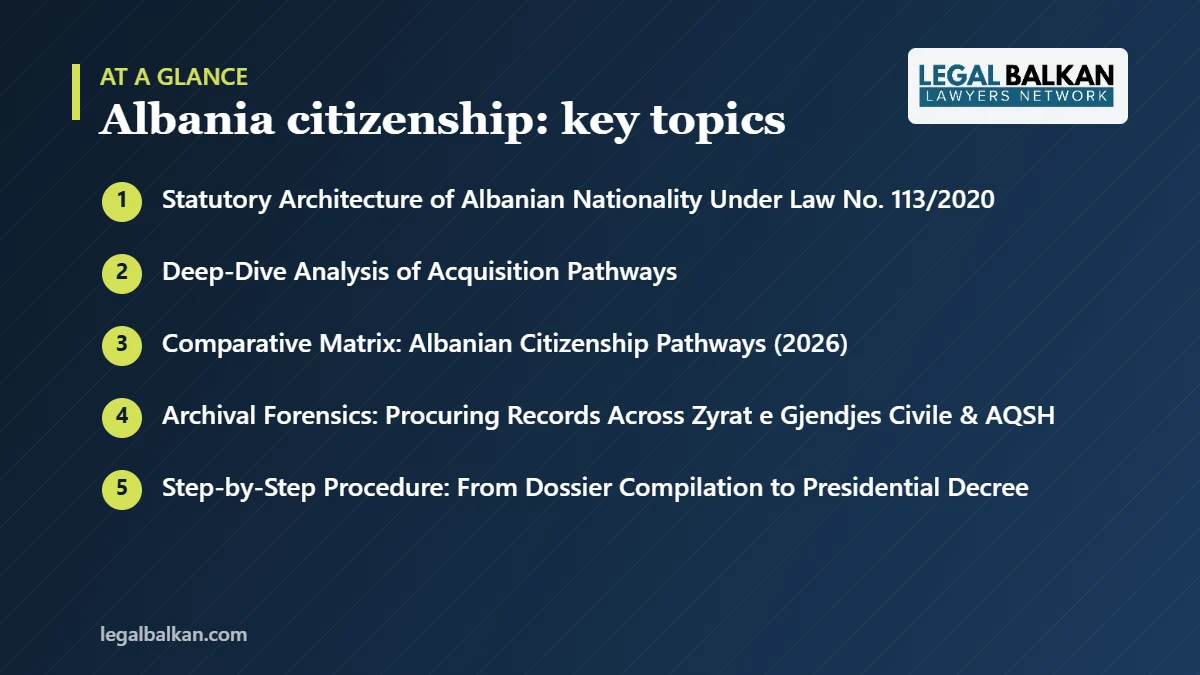
2. Five Pathways to Albanian Citizenship
Pathway A: Citizenship by Origin Up to the Third Degree (Article 6 - The Flagship Pathway)
The hallmark statutory innovation of Law No. 113/2020 is codified in Article 6, read together with the definition of "origin" in Article 2(d), which expanded the right of return for the global Albanian diaspora. Under Article 6:
Statutory Text of Article 6 (Law No. 113/2020, unofficial translation):
"1. Albanian citizenship is acquired by a foreigner whose ancestors are of Albanian origin, provided that the direct-line family relationship between the applicant and the ancestor, up to three degrees, is proven. 2. In this case the person submits a request for acquisition of Albanian citizenship on the basis of origin and meets the criteria of letters 'dh' and 'ë' of paragraph 1 of Article 8 of this Law."
Key Legal Characteristics of Article 6:
- Generational Depth (Up to the Third Degree): Under the Albanian Civil Code, lineal degrees of consanguinity are calculated from generation to generation. The third degree encompasses:
- First Degree: Parents (father or mother).
- Second Degree: Grandparents (grandfather or grandmother).
- Third Degree: Great-grandparents (great-grandfather or great-grandmother).
This means that an applicant whose great-grandfather emigrated from Albania in the early 20th century possesses full statutory standing to claim Albanian citizenship.
- No Residence Requirement: Article 6 refers only to the criminal-record and security conditions of Article 8(1)(dh) and (ë). Applicants are therefore not required to hold an Albanian residence permit or to have lived in Albania.
- No Language Examination: Unlike general naturalization candidates, descent applicants do not have to prove knowledge of the Albanian language or history, because the language condition of Article 8(1)(e) does not apply to them.
- Dual Citizenship: Applicants keep their existing foreign citizenship; the Law does not require renunciation.
Pathway B: Automatic Citizenship by Birth (Article 5)
Under Article 5 of the Law, anyone born with at least one parent who holds Albanian citizenship acquires Albanian citizenship automatically and is registered as an Albanian citizen:
- This applies whether the child was born in Albania or abroad, and whether one or both parents are Albanian citizens.
- No parental agreement, residence or language condition is required: the citizenship arises by operation of law at birth.
- The right to be registered as an Albanian citizen does not expire, even after the person has turned 18 (Article 5).
Pathway C: Standard Naturalization Through Continuous Residency (Article 8)
Foreign nationals who lack documented Albanian genealogical roots can apply for naturalization under Article 8(1) of Law No. 113/2020 by satisfying the following cumulative criteria:
- Age and Capacity: Must have reached 18 years of age and hold full legal capacity.
- Seven-Year Lawful Residence: Must be staying lawfully in Albania, have resided there continuously for at least seven (7) years, and hold a permanent residence permit under the law on foreigners that is valid on the date of application (Article 8(1)(c)).
- Housing and Means of Subsistence: Must have housing that meets the approved housing standards and lawful income and financial resources sufficient for living in Albania, corresponding to the minimum living standard indexed every year (Article 8(1)(ç)–(d)).
- Language and History: Must know spoken and written Albanian, certified by the relevant educational institution, and have basic knowledge of the history of the Republic of Albania under rules set by higher-education institutions (Article 8(1)(e)).
- Criminal Record: Must not have been convicted by a final court decision, in the home state, in Albania or in a third state, of a criminal offence for which Albanian law provides imprisonment of at least three (3) years, unless the conviction was politically motivated (Article 8(1)(dh)).
- Public Order and National Security: Must not pose a threat to the public order and national security of the Republic of Albania (Article 8(1)(ë)).
- Stateless Persons: A stateless person needs to meet only the seven-year residence, criminal-record and security conditions (Article 8(2)).
- Parents of Albanian Children: A foreigner whose minor child holds Albanian citizenship may apply after at least three (3) years of lawful and continuous residence, without the permanent-permit condition (Article 8(4)).
- Refugees and Subsidiary Protection: Refugees and persons under subsidiary protection can apply after seven (7) years of lawful and continuous residence counted from the decision granting their status (Article 11).
Pathway D: Naturalization Through Marriage (Article 8(3))
Foreign spouses of Albanian citizens benefit from facilitated naturalization under Article 8(3):
- The applicant must have been married to an Albanian citizen for at least three (3) years.
- The applicant must have resided lawfully and continuously in Albania for at least one (1) year.
- The spouse is exempt from the seven-year residence and permanent-permit condition and from the language and history condition; age, legal capacity, housing, income, criminal-record and security conditions still apply.
Pathway E: Special Cases of National Interest (Article 9)
Under Article 9 of the Law, Albanian citizenship may be acquired by a foreign national aged 18 or over who does not pose a threat to public order and national security, where the Republic of Albania has a national interest or an interest in education, science, art, culture, economy or sport. The criteria for these special programmes, the application procedure and the security checks are set by decision of the Council of Ministers, and a dedicated state agency under the Minister applies the highest vetting standards. The ordinary filing and review procedure of Articles 17 and 18 does not apply, and the oath may also be taken at an Albanian diplomatic or consular mission (Article 21).
3. Comparative Matrix: Albanian Citizenship Pathways (2026)
| Pathway | Statutory Basis | Residency Requirement | Dual Citizenship? | Language Exam? | Generational Scope |
|---|---|---|---|---|---|
| Origin (Descent) | Article 6 | None | Yes | Exempt | Up to 3rd degree (great-grandparents) |
| Birth to an Albanian Parent | Article 5 | None | Yes | Exempt | Children of citizens |
| Standard Naturalization | Article 8(1) | 7 years + permanent permit | Yes | Required | Individual applicant |
| Spousal Naturalization | Article 8(3) | 1 year (3 yrs marriage) | Yes | Exempt | Spouse |
| Parent of an Albanian Child | Article 8(4) | 3 years | Yes | Required | Parent |
| Special National Interest | Article 9 | Set by Council of Ministers decision | Yes | Exempt | Individual applicant |
4. Archival Forensics: Procuring Records Across Zyrat e Gjendjes Civile & AQSH
To substantiate an Article 6 claim for Albanian citizenship by descent, the petitioner must reconstruct an unbroken, certified genealogical link connecting the applicant to the qualifying Albanian ancestor. This evidentiary process requires comprehensive archival searches across two primary institutional repositories in Albania:
1. Municipal Civil Status Offices (Zyrat e Gjendjes Civile)
Every municipality (Bashki) in Albania maintains a territorial civil status office under the supervision of the General Directorate of Civil Status. These offices preserve physical and digitized registers dating from 1928 through the communist period to the present day. Key documents retrieved include:
- Certifikatë Lindjeje (Birth Certificate): Confirming the ancestor’s full legal name, date and exact locality of birth, and biological parentage.
- Certifikatë Familjare (Family Certificate / Tree Extract): A vital statutory document under Albanian civil practice that outlines the historical household composition, documenting marriages, children, and emigrations in an official genealogical hierarchy.
- Certifikatë Martese dhe Vdekjeje (Marriage and Death Certificates): Validating lawful succession and transmission of rights across generations.
2. Central State Archives of Albania (Arkivi Qendror i Shtetit - AQSH)
For ancestral roots originating prior to the establishment of modern civil registers (pre-1928), or where municipal registers were damaged during historical conflicts, archival petitions must be directed to the Central State Archives (AQSH) in Tirana. AQSH houses historic Ottoman population registers (Defterët e popullsisë), parish and mosque books, census ledgers of the Kingdom of Albania (1928–1939), and post-war repatriation decrees.
Evidentiary Best Practice: In historical migration records—particularly among Albanian emigrants who relocated to Turkey, Italy, or Egypt—surnames were frequently truncated or adapted to local naming conventions. Legal Balkan initiates administrative reconciliation proceedings (Ndreqje e gabimeve materiale në aktet e gjendjes civile) before Albanian civil status offices to harmonize historical records before final filing.
5. Albanian Citizenship Application: From Dossier to Presidential Decree
Phase 1: Genealogical Lineage Audit
Legal Balkan’s immigration attorneys review existing family documents, migration passports, foreign birth certificates, and oral family history to establish the exact ancestral locality in Albania and verify that the claim falls strictly within the third degree of lineage.
Phase 2: On-Site Archival Procurement in Albania
Operating under a notarized Power of Attorney (Prokurë e Posaçme), our attorneys in Tirana, Shkodra, Vlora, Korça, Durrës, and other municipalities search the civil status archives to obtain certified Certifikatë Lindjeje and historical Certifikatë Familjare.
Phase 3: International Legalization & Apostille
All foreign documents establishing the line of descent (birth certificates of the applicant and intermediary parents, marriage certificates) must be authenticated with the Hague Apostille stamp in the country of issuance.
Phase 4: Certified Court Translation (Përkthim Zyrtar)
Foreign apostilled documents are translated into the Albanian language by a licensed court interpreter certified by the Ministry of Justice of the Republic of Albania.
Phase 5: Formal Application Submission
Requests for acquisition of citizenship are submitted to the local State Police structure at the applicant's place of residence (Article 17(1)); the Ministry also accepts filing through e-Albania, and foreign applicants must apply in person. Albanian diplomatic and consular missions accept only renunciation and reacquisition requests from persons living abroad (Article 17(2)).
Phase 6: Security Checks and Ministry Review
The local State Police carries out the public-security checks and sends the file to the Ministry within one month. The Ministry then has six (6) months to verify the conditions and send a proposal for a decree to the President. Incomplete files are returned within 45 days, and the applicant is notified within 15 days to complete them. A refusal is issued as an administrative act of the Minister and can be appealed to the competent administrative court (Article 18).
Phase 7: Enactment of Presidential Decree & Passport Issuance
The President of the Republic issues the decree within 60 days of the Ministry's proposal (Article 20), and it is published in the Official Gazette. The new citizen must take the oath of loyalty before the mayor of the municipality of residence, or an authorized official, within six (6) months of notification; otherwise the decree has no effect. This deadline can be extended for objective reasons by up to 12 months (Articles 21–22). The applicant then receives the biometric Albanian passport and identity card (Letërnjoftim Elektronik).
6. Strategic & Commercial Privileges of Albanian Citizenship (2026 Horizon)
Holding citizenship of the Republic of Albania offers significant strategic advantages:
- Global & European Schengen Mobility: The biometric Albanian passport grants visa-free access to over 125 destinations worldwide, including 90 days of visa-free travel within any 180-day window throughout the 27 nations of the European Schengen Area.
- EU Accession Trajectory: As an EU candidate country progressing through formal accession negotiations (European Commission DG NEAR), Albanian citizens are positioned at the forefront of future European Single Market rights and freedom of movement.
- Favorable Tax Environment: Albania features attractive corporate and personal tax incentives, including a 0% corporate tax rate for qualifying micro-businesses and substantial incentives for IT, software development, and renewable energy sectors.
- Direct Eurasian & Mediterranean Trade Access: Strategic geographic positioning along Pan-European Corridor VIII, offering deep-water maritime logistics via the Port of Durrës connecting Italy, the Western Balkans, and Turkey.
- Unrestricted Property Ownership: Foreign citizens often face statutory hurdles when buying agricultural land in the Balkans; as an Albanian citizen, property acquisition and development rights are absolute.
7. Albanian Citizenship FAQ
1. How many generations back can I claim Albanian citizenship by descent?
Under Article 6 of Law No. 113/2020 on Citizenship, foreign nationals can claim Albanian citizenship by origin up to the third degree of direct lineage, encompassing parents (1st degree), grandparents (2nd degree), and great-grandparents (3rd degree).
2. Does Albania permit dual citizenship in 2026?
Yes. Albanian citizenship law fully recognizes and protects dual and multiple citizenships across all acquisition pathways. Applicants are not required to renounce or surrender their existing nationality.
3. Is there a language test required for claiming Albanian citizenship by origin?
No. Applicants under Article 6 (citizenship by origin) only have to meet the criminal-record and national-security conditions of Article 8(1)(dh) and (ë). They do not take a language or history test and do not need an Albanian residence permit.
4. What is the residency requirement for Albanian citizenship by naturalization?
Under Article 8(1)(c) of Law No. 113/2020, general naturalization requires lawful stay and at least seven (7) years of continuous residence in Albania, together with a permanent residence permit that is valid on the date of application.
5. What documents are required to prove Albanian ancestry?
Applicants must present an unbroken documentary chain of vital civil status records, including family registry certificates (Certifikatë Familjare), birth certificates (Certifikatë Lindjeje) from Albanian Civil Status Offices (Zyrat e Gjendjes Civile) or the Central State Archives (AQSH), apostilled foreign civil records, and certified translations by a sworn court interpreter.
6. How long does the Albanian citizenship by descent process take?
By law, the police forward the file within one month, the Ministry has six months to review it, and the President has 60 days to issue the decree (Articles 18 and 20). In practice, including document collection and requests for missing documents, the process usually takes between 6 and 14 months.
7. Can spouses of Albanian citizens acquire citizenship on an expedited basis?
Yes. Under Article 8(3) of Law No. 113/2020, a foreign spouse married to an Albanian citizen for at least three (3) years who has resided lawfully and continuously in Albania for at least one (1) year may apply for naturalization without meeting the seven-year residence and language conditions.
8. Who makes the final statutory decision to grant Albanian citizenship?
The Ministry of Interior examines the file and sends a proposal to the President of the Republic, who issues the decree granting Albanian citizenship (Article 20). The decree takes effect only after the applicant takes the oath of loyalty within the legal deadline (Article 22).
9. Can minor children acquire Albanian citizenship alongside their parents?
Yes. Under Article 8(5)–(6) of Law No. 113/2020, if both parents are naturalized, their children under 18 who live with them acquire citizenship at the parents' request, with the child's consent from age 14. If only one parent is naturalized, the child acquires citizenship at the request of both parents, or of one parent with the other's consent, if the child lives in Albania. Children born to an Albanian citizen are citizens by birth under Article 5.
10. Can Legal Balkan assist with archival searches in Albania remotely?
Yes. Acting through a specialized Power of Attorney (Prokurë e Posaçme), Legal Balkan attorneys conduct on-site archival searches across municipal Civil Status Offices and the Central State Archives in Tirana, assembling the complete legal dossier.
Authoritative Statutory Citations & Official Portals
- Ministry of Interior of the Republic of Albania (Ministria e Punëve të Brendshme): official text of Law No. 113/2020 "On Citizenship" and citizenship procedures. https://mb.gov.al
- Center of Official Publications of Albania (Qendra e Botimeve Zyrtare - QBZ): Consolidated Law No. 113/2020 on Citizenship. https://qbz.gov.al
- President of the Republic of Albania: Official presidential decrees on citizenship. https://president.al
- Central State Archives of Albania (Arkivi Qendror i Shtetit - AQSH): Historical genealogical registers and population records. http://arkiva.gov.al
- European Commission - Directorate-General for Neighbourhood and Enlargement Negotiations: Albania EU accession reports. European Commission Albania Country Overview
Retain Legal Balkan for Your Albanian Citizenship Claim
With dedicated on-the-ground archival researchers and seasoned nationality attorneys in Tirana and across Albania, Legal Balkan provides turnkey representation under Law No. 113/2020 from historical vital records procurement to passport issuance.Schedule an Albanian Lineage Legal Assessment
Related Legal Guides
Have a question about your own case? Contact Legal Balkan for a confidential first assessment.