Practice Area: International Immigration Law, Family Reunification & Cross-Border Civil Status Harmonization
Jurisdictions: Republic of Serbia • Republic of North Macedonia • Regional Western Balkans
Governing Statutes: Zakon o strancima (RS Off. Gazette Nos. 24/2018, 31/2019, 62/2023) • Zakon za strancite (RNM Off. Gazette Nos. 97/2018, 108/2019, 142/2024) • ECHR Article 8
Competent Authorities: Ministry of Interior of Serbia (MUP) • e-Uprava Portal • National Employment Service (NSZ) • Ministry of Internal Affairs of North Macedonia (MVR) • Ministry of Justice • e-Uslugi Portal
The legal frameworks governing Family Reunification in Serbia and North Macedonia reflect a sophisticated intersection of national sovereign prerogative, European human rights jurisprudence, and modernized administrative procedure. For foreign professionals, international corporate transferees, and diaspora families establishing roots across Southeast Europe, uniting immediate family members represents both a fundamental human right and a rigorous regulatory undertaking. Both jurisdictions have undergone sweeping legislative overhauls—Serbia via its modernized Zakon o strancima and electronic Unified Permit system, and North Macedonia through its updated Zakon za strancite and National Visa D protocols. This comprehensive legal treatise delivers an exhaustive statutory, comparative, and evidentiary analysis of family reunification procedures across both sovereign nations, providing institutional guidance for cross-border applicants and corporate sponsors.
Navigating cross-border family reunification in the Western Balkans requires navigating two distinct administrative paradigms. While the Republic of Serbia has implemented an integrated digital ecosystem through the e-Uprava governmental portal—consolidating temporary residence (*privremeni boravak*) and work authorization into a single biometric card (*Jedinstvena dozvola*)—the Republic of North Macedonia maintains a traditional bifurcated consular and territorial procedure anchored by the National Long-Stay Visa D (*Viza D za spojuvanje na semejstvo*).
Prospective applicants must also address complex evidentiary mandates under the 1961 Hague Apostille Convention, civil status certifications under the CIEC framework, certified court translations, and domestic proof of financial subsistence. For prospective sponsors and legal counsel managing family relocations, understanding these statutory divergences is essential to avoid administrative refusals, procedural delays, or re-entry bans.
Table of Contents
Key Statutory and Procedural Findings:
- Digital Integration in Serbia: Serbia has fully digitized family reunification filings via the e-Uprava portal, abolishing paper stamps in passports and granting up to 3-year biometric Unified Permits with automatic employment authorization for reunified spouses.
- Consular Visa D Mandate in North Macedonia: North Macedonia strictly mandates that foreign family members secure a long-term National Visa D from a diplomatic-consular mission abroad prior to territorial entry, followed by biometric registration with the Ministry of Internal Affairs (MVR).
- Accelerated Permanent Residency: Following Serbia's 2023 legislative amendments, the residency qualification for permanent residence (*stalno nastanjenje*) has been dramatically reduced from 5 years to 3 years. In North Macedonia, the general period remains 5 years, though spouses of citizens can qualify after 3 continuous years.
- Strict Authentication Regime: All foreign civil status records (marriage extracts, birth certificates) must bear the 1961 Hague Apostille or be issued under CIEC multilingual conventions, accompanied by court-certified sworn translations executed exclusively by locally licensed court interpreters.
1. International Legal Architecture: Family Reunification in Serbia and North Macedonia Under ECHR Article 8
The statutory frameworks governing Family Reunification in Serbia and North Macedonia are not isolated constructs of domestic immigration statutes; they are deeply anchored in international public law and European human rights jurisprudence. The cornerstone of cross-border family protection across the Council of Europe space is Article 8 of the European Convention on Human Rights (ECHR), which guarantees the right to respect for private and family life (*Avrupa İnsan Hakları Sözleşmesi Madde 8 - Özel ve Aile Hayatına Saygı Hakkı*). Both the Republic of Serbia (ratified in 2004) and the Republic of North Macedonia (ratified in 1997) are contracting parties to the Convention, and by virtue of their respective constitutional provisions, ratified international treaties take precedence over conflicting domestic statutes.
Under established case law of the European Court of Human Rights—including seminal judgments such as Boultif v. Switzerland (Application no. 54273/00), Üner v. the Netherlands (Application no. 46410/99), and Jeunesse v. the Netherlands (Application no. 12738/10)—the Court has firmly established that while Contracting States enjoy a sovereign prerogative to regulate the entry and residence of non-citizens, this prerogative is subject to positive obligations to respect core family life.
When a state refuses an entry clearance, denies temporary residence, or threatens deportation that effectively fractures a genuine marital or parental bond, it must demonstrate that the interference is "necessary in a democratic society" and proportionate to a legitimate statutory aim (such as national security or the prevention of disorder). Domestic immigration tribunals and police directorates in Belgrade and Skopje are legally bound to apply this proportionality test.
Furthermore, both sovereign states are formal candidates for European Union accession and are actively negotiating Chapter 24 (Justice, Freedom, and Security). In this accession context, both national legislatures have systematically benchmarked their immigration legislation against European Union Directive 2003/86/EC on the right to family reunification. This harmonization drive has led to the codification of standardized definitions of immediate family members (*spajanje porodice* in Serbian, *spojuvanje na semejstvo* in Macedonian, and *aile birleşimi hakkı* in cross-border Turkish legal terminology), explicit statutory timelines for administrative adjudication, and protected procedural avenues for administrative and judicial appeal before domestic courts. The United Nations High Commissioner for Refugees (UNHCR) also oversees regional family reunification standards for beneficiaries of international protection.
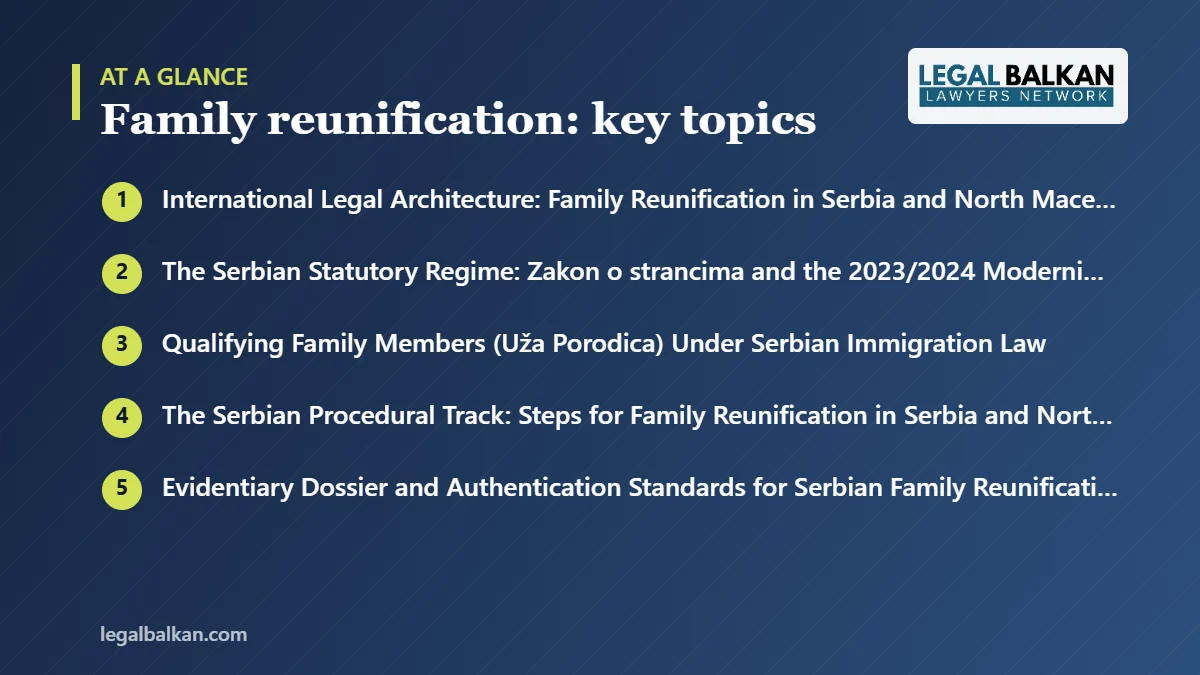
2. The Serbian Statutory Regime: Zakon o strancima and the 2023/2024 Modernization
In the Republic of Serbia, the immigration architecture underwent a transformative overhaul with the enactment of the comprehensive Amendments to the Zakon o strancima (Law on Foreigners, Official Gazette of the Republic of Serbia Nos. 24/2018, 31/2019, and 62/2023), which fully entered into statutory force in February 2024. Together with corresponding revisions to the Law on Employment of Foreigners (*Zakon o zapošljavanju stranaca*), this legislative package positioned Serbia as one of the most operationally modern jurisdictions in Southeast Europe for foreign professionals, international entrepreneurs, and their accompanying dependents.
Articles 55 through 60 of the Zakon o strancima govern the grant and renewal of temporary residence (*privremeni boravak / geçici oturma izni*) on grounds of family reunification (*spajanje porodice / aile birleşimi*). Prior to the 2023 amendments, foreign family members endured a fragmented administrative regime: temporary residence was adjudicated by the Ministry of Interior (MUP), paper residency stickers were affixed inside foreign passports, and spouses wishing to engage in gainful employment were subjected to secondary labour market certifications before the National Employment Service (NSZ). Under the modernized statutory regime, this cumbersome dual-agency process has been completely abolished.
The cornerstone of the Serbian reform is the introduction of the Unified Permit (*Jedinstvena dozvola / Birleşik İkamet ve Çalışma İzni*), codified under Articles 46a through 46z of the statute. While foreign sponsors employed in Serbia or operating corporate enterprises obtain a Unified Work and Residence Permit, their accompanying family members receive a standardized biometric residence identity card (*biometrijska boravišna karta / biyometrik oturum kartı*). Key structural innovations enacted by the 2023 statutory amendments include:
- Extended Permit Duration (Up to 3 Years): Under the amended Article 57, temporary residence on grounds of family reunification can now be granted for an initial term of up to three (3) years, or for the duration of the sponsor's valid permit if shorter. This eliminates the onerous requirement of annual bureaucratic renewals that previously characterized Serbian immigration practice.
- Direct Work Authorization for Dependent Spouses: Under the amended Law on Employment of Foreigners, a foreign spouse granted temporary residence on the basis of family reunification with a Serbian citizen, permanent resident, or temporary resident holding a unified permit enjoys personal work authorization (*pravo na rad bez posebnog odobrenja / doğrudan çalışma izni ve hakkı*). They can enter into an employment contract or engage in independent entrepreneurial activities without undergoing a domestic labour market test (*test tržišta rada*).
- Biometric Card Issuance: Passport residence stickers have been fully phased out in favor of biometric chip cards containing cryptographic facial and fingerprint identifiers, fully harmonized with EU security standards.
3. Qualifying Family Members (Uža Porodica) Under Serbian Immigration Law
The statutory definition of family members entitled to claim reunification under Serbian law is strictly codified under Article 55 of the Zakon o strancima. Serbian immigration jurisprudence distinguishes between the core "immediate family" (*uža porodica / çekirdek aile*), who possess a direct statutory entitlement to residency, and extended family members, who can qualify only under exceptional humanitarian circumstances.
A. Registered Spouses (Bračni Drugovi / Resmi Nikahlı Eşler)
A legally married spouse of a Serbian citizen, a permanent resident (*stranac na stalnom nastanjenju*), or a foreigner holding valid temporary residence or a unified permit is entitled to family reunification. The marriage must be legally valid under the domestic law of the country where it was celebrated and must not contravene Serbian public order (*javni poredak*).
To combat immigration fraud, Article 58 of the Zakon o strancima contains strict provisions against marriages of convenience (*brak iz interesa / muvazaalı evlilik*). MUP inspectors possess statutory authority to conduct unannounced home visits, interview spouses independently, and verify whether a genuine matrimonial community exists. If a marriage is deemed fictitious, temporary residence is summarily denied or revoked, and a formal expulsion order is issued.
B. Common-Law Partners (Vanbračni Partneri / Nikahsız Birlikte Yaşayan Eşler)
In progressive alignment with modern European family law, Article 55, Paragraph 3 of the Zakon o strancima recognizes common-law cohabiting partners (*vanbračni partneri*) as eligible members of the immediate family. However, the evidentiary threshold to establish a common-law union is rigorous.
Applicants must produce: (1) certificates of unmarried status (*uverenje o slobodnom bračnom stanju / bekarlık belgesi*) proving neither party is legally married to a third person; (2) documentary proof of uninterrupted cohabitation for a minimum period of two (2) years prior to filing, or proof of a shared biological or adopted child; and (3) certified statements from two witnesses executed before a notary public (*javni beležnik / noter tasdikli beyan*) attesting to the permanence and continuity of the emotional and economic partnership.
C. Minor Biological and Adopted Children (Maloletna Deca / Reşit Olmayan Çocuklar)
Minor children under eighteen (18) years of age born within wedlock, out of wedlock, or legally adopted are entitled to reunification with their parent(s). If the child is reuniting with only one parent while the other parent resides outside Serbia, the petitioning parent must submit a certified, apostilled consent statement (*saglasnost drugog roditelja / muvafakatname*) executed by the non-accompanying parent, or an authoritative court decree establishing sole parental responsibility and custody (*odluka suda o vršenju roditeljskog prava / velayet kararı*).
D. Dependent Parents and Adult Children (Roditelji / Bakmakla Yükümlü Olunan Anne ve Baba)
Under Article 55, Paragraph 4, direct ascendants (parents - *roditelji*) and adult children who are severely incapacitated due to certified chronic medical conditions or mental disability may qualify for family reunification under strict conditions of dependency. The applicant must demonstrate that the dependent family member is entirely reliant upon the sponsor for financial and physical care, has no other surviving children or close relatives in their country of origin capable of providing support, and possesses no independent income or pension sufficient for self-sustenance.
4. The Serbian Procedural Track: Steps for Family Reunification in Serbia and North Macedonia via e-Uprava
The procedural execution of Family Reunification in Serbia and North Macedonia demonstrates substantial administrative variation. In Serbia, following the 2024 digitalization mandates, all applications for temporary residence on family grounds must be initiated through the central national portal e-Uprava under the dedicated Ministry of Interior foreign registry interface. The workflow proceeds through five coordinated statutory stages:
Operational Roadmap: Navigating Family Reunification in Serbia and North Macedonia Step-by-Step
Successfully completing family reunification in Serbia requires synchronized execution between local accommodation registration, digital document authentication, and police biometric enrollment. Understanding each procedural milestone ensures zero administrative friction for relocating families.
Stage 1: Lawful Entry and Residential Registration (Prijava Boravišta / Beli Karton / İkametgah Bildirimi)
A foreign family member may enter Serbia pursuant to a visa-free regime (e.g., EU, Turkish, UK, or US passport holders) or under a valid long-term Visa D (*D Tipi Vize*) issued by a Serbian diplomatic-consular mission abroad. Within twenty-four (24) hours of arrival at their residential accommodation, the foreigner must be officially registered with the local territorial police station (*policijska stanica*). This produces the mandatory residential registration certificate, colloquially known as the "white card" (*beli karton / beyaz kart*). Accommodation providers (hotels, registered rental landlords) execute this electronically, while private landlords must appear with the tenant or file via the e-Turista / MUP portal.
Stage 2: Digital Application Submission via e-Uprava
The application is compiled and uploaded electronically via the e-Uprava platform. Authorized legal counsel, acting under a formal Power of Attorney (*Punomoćje / Vekaletname*), can register and submit the electronic dossier on behalf of the client. All evidentiary exhibits—including passports, civil certificates, proof of accommodation, and financial guarantees—must be uploaded in standardized high-resolution PDF format. The mandatory administrative state fees are calculated and paid electronically through the integrated e-Plati payment gateway.
Stage 3: MUP Administrative Review and Security Clearance
Upon electronic transmission, the file is assigned to an inspector at the competent Directorate for Foreigners (*Uprava za strance*)—such as the central directorate in Belgrade (located at Savska 35 and Omladinskih brigada 1) or regional police directorates (*Policijske uprave*) in Novi Sad, Niš, or Kragujevac. Under Article 40 of the *Zakon o strancima* and the Law on General Administrative Procedure (*ZUP*), MUP has a statutory deadline of thirty (30) days to review the application and render an administrative determination.
Stage 4: In-Person Biometric Enrollment
Once preliminary administrative approval is recorded in the e-Uprava portal, the applicant receives a formal appointment invitation to appear at the Directorate for Foreigners for biometric data capture. The foreign family member must present their original valid passport for visual inspection and submit high-resolution live facial photography, digital ten-print fingerprints, and an electronic signature.
Stage 5: Biometric Card Production and Collection
Following biometric enrollment, the official biometric residence card (*biometrijska boravišna karta / biyometrik oturma izni kartı*) is manufactured by the National Bank of Serbia's Institute for Manufacturing Banknotes and Coins (ZIN) and delivered to the issuing police directorate within 7 to 14 business days. The applicant (or authorized counsel possessing special collection authority) collects the physical card, formalizing lawful temporary residence in the Republic of Serbia for up to three years.
5. Evidentiary Dossier and Authentication Standards for Serbian Family Reunification
Under Serbian administrative law, the burden of proving qualifying family relationships and statutory criteria rests strictly upon the applicant and their sponsor. MUP inspectors enforce rigorous documentary standards; incomplete or unauthenticated dossiers will trigger formal deficiency notices (*zaključak o otklanjanju nedostataka*) under Article 59 of ZUP, or lead to outright rejection. The standard evidentiary dossier comprises:
- Valid Travel Document: A valid international passport possessing at least two consecutive blank pages and an expiration date extending at least three (3) months beyond the requested duration of temporary residence.
- Proof of Marital or Kinship Link: An international multilingual marriage certificate (issued under the 1976 Vienna CIEC Convention - Form B / *Formül B Evlenme Kayıt Örneği*) or an apostilled national marriage extract. For minor children, an international multilingual birth extract (CIEC Form A / *Formül A Doğum Kayıt Örneği*) or apostilled birth certificate naming both parents is required.
- Sworn Certified Translation: Any foreign document not issued on a standard multilingual CIEC extract must be translated into the Serbian language (Cyrillic script) by a court-certified sworn translator (*ovlašćeni sudski tumač / yeminli tercüman*) registered with the Serbian Ministry of Justice. Translations executed abroad by non-Serbian court interpreters are legally inadmissible.
- Proof of Secured Residential Accommodation: A residential lease agreement (*ugovor o zakupu stana / noter tasdikli kira sözleşmesi*) executed with the property owner and certified before a Serbian public notary (*javni beležnik / noter onayı*). The lease must be accompanied by an official extract from the Real Estate Cadastre (*izvod iz lista nepokretnosti* issued by RGZ) confirming the landlord's title. If the sponsor owns real estate in Serbia, an up-to-date cadastral ownership certificate suffices.
- Proof of Means of Subsistence: Verifiable documentation proving the family has sufficient financial means without burdening the social assistance budget. Acceptable proofs include the sponsor's employment contract and certified payroll slips (*obračun zarada*), bank account deposit certificates issued by a Serbian commercial bank demonstrating funds exceeding the statutory minimum net wage per dependent, or certified corporate dividend distributions if the sponsor owns an operational Serbian company. For corporate entity setup and director work permits, explore our specialized company establishment services.
- Comprehensive Health Insurance: A valid health insurance policy (*özel sağlık sigortası*) covering emergency and standard medical treatments across Serbia. This may consist of state health fund registration (RFZO) via the sponsor's formal employment, or a private international health insurance policy with coverage of at least €20,000 to €30,000 for the duration of stay.
- Criminal Clearance Certificate: A police clearance certificate (*uverenje o nekažnjavanju / adli sicil kaydı - sabıka belgesi*) issued by the competent national authority of the applicant's country of origin and last permanent residence, authenticated with the Hague Apostille and translated into Serbian.
6. Transition to Permanent Residency (Stalno Nastanjenje) and Naturalization in Serbia
A monumental achievement of Serbia's 2023 immigration reforms is the radical shortening of the pathway to permanent residency (*stalno nastanjenje / süresiz oturma izni - daimi ikamet*). Under Article 67 of the amended Zakon o strancima, the standard residency threshold required to petition for permanent residence was lowered from five (5) years to just three (3) years of uninterrupted continuous temporary residence. This makes Serbia one of the fastest legal pathways to permanent residence in all of Europe.
For spouses of Serbian citizens, the legal mechanism is particularly advantageous. Article 68, Paragraph 1, Item 1 stipulates that a foreigner who has resided continuously in Serbia for at least three (3) years on grounds of temporary residence, and who has been married to a citizen of the Republic of Serbia for that entire period, possesses the statutory right to be granted permanent residence. During this 3-year qualifying period, the applicant must not have been absent from Serbian territory for more than ten (10) months in the aggregate, or more than six (6) consecutive months.
Once granted permanent residence (*stalno nastanjenje*), the foreign spouse is issued a permanent biometric identity card (*stalna lična karta za strance*) valid for five (5) years and renewable indefinitely. Permanent residence confers full parity with Serbian citizens across the labour market, real estate acquisition, social welfare, and commercial enterprise, with the sole exception of voting rights.
Furthermore, permanent residents married to Serbian citizens become immediately eligible to petition for Serbian citizenship by naturalization under Article 17 of the Law on Citizenship of the Republic of Serbia (*Zakon o državljanstvu Republike Srbije*). Under this provision, the foreign spouse can acquire Serbian citizenship (*državljanstvo prirođenjem / evlilik yoluyla vatandaşlık kazanımı*) without renouncing their original nationality, making dual citizenship (*çifte vatandaşlık*) fully accessible. For comprehensive guidance on lineage and citizenship pathways, consult our treatise on Serbia Citizenship by Descent & Naturalization.
7. The North Macedonian Statutory Regime: Zakon za strancite and the 2024 Legal Framework
In the Republic of North Macedonia, the statutory architecture governing foreign nationals is codified in the Zakon za strancite (Law on Foreigners / *Kuzey Makedonya Yabancılar Kanunu*, Official Gazette of the Republic of Macedonia Nos. 97/2018, 108/2019, and Official Gazette of the Republic of North Macedonia No. 142/2024). Temporary residence on grounds of family reunification (*privremen prestoj za spojuvanje na semejstvo / aile birleşimi oturma izni*) is regulated under Chapter IV, Articles 60 through 68 of the statute.
Unlike Serbia's integrated digital procedure, North Macedonia maintains a dual-track administrative model supervised by the Ministry of Internal Affairs (MVR - Ministerstvo za vnatrešni raboti / İçişleri Bakanlığı), specifically the Department for Border Affairs and Migration (*Sektor za granični raboti i migracii*), operating in coordination with diplomatic-consular representations abroad and regional migration sectors. The Ministry of Justice (Pravda) and the national e-services platform e-Uslugi oversee supporting civil registry and documentation modules.
The North Macedonian statutory regime operates under a foundational principle: a foreign national who wishes to reunite with a family member in North Macedonia must generally initiate the process from outside the country by applying for a long-term entry visa, rather than entering on a short-term tourist stay and adjusting status domestically. While bilateral exceptions exist, strict adherence to this consular prerequisite is vital to avoiding administrative dismissal.
8. Eligible Beneficiaries and Family Unit Concepts Under North Macedonian Law
Article 61 of the Zakon za strancite provides an exhaustive statutory enumeration of individuals qualifying as members of the immediate family (*členovi na potesnoto semejstvo / çekirdek aile üyeleri*). In North Macedonian immigration practice, administrative authorities apply strict formalism when assessing kinship bonds:
- Legally Married Spouses (Bračni Drugari / Resmi Nikahlı Eşler): Spouses who have entered into a valid civil marriage recognized under North Macedonian family law (*Zakon za semejstvoto*). Crucially, North Macedonian immigration law does not recognize unregistered common-law partnerships (vonbračni zaednici) as a valid basis for family reunification residence permits. Only formal civil marriages documented by official civil marriage registers are admissible.
- Minor Children (Maloletni Deca / Reşit Olmayan Çocuklar): Unmarried minor children under eighteen (18) years of age born of both spouses, or born of one spouse provided that the sponsoring spouse exercises lawful legal custody and parental rights pursuant to an official judicial decision or authenticated parental agreement. Legally adopted children (*posvoeni deca*) enjoy identical statutory standing upon presentation of an authentic adoption decree.
- Adult Dependent Children: Unmarried adult children over 18 years of age who, due to severe medical, physical, or mental disabilities, are objectively incapable of satisfying their own vital needs and are completely dependent upon the financial and personal care of the sponsoring parent(s). Rigorous medical documentation from recognized health institutions is mandatory.
- First-Degree Ascendants (Dependent Parents - Roditeli / Bakmakla Yükümlü Olunan Anne ve Baba): Direct ascendant parents of the sponsor or spouse who, due to advanced age, severe physical infirmity, or lack of any other familial support in their home country, are provably dependent upon the sponsor. MVR scrutinizes parental reunification petitions with extreme rigor to ensure the family will not burden the state social assistance framework.
Under Article 63 of the Zakon za strancite, MVR inspectors are legally mandated to investigate and prevent marriages of convenience (*brak od korist / anlaşmalı evlilik*). If registry records, investigative interviews, or home inspections reveal that the marriage was concluded solely to obtain an entry visa or residence title without a genuine intention to lead a marital life, the application will be denied, any existing permit revoked, and an administrative re-entry ban imposed under Article 114 of the statute.
9. The North Macedonian Procedural Track: National Visa D and MVR Registration
The procedural trajectory for family reunification in North Macedonia consists of two interlinked administrative phases: consular clearance abroad and in-country biometric issuance. This structured procedure ensures comprehensive background vetting before the foreign family member establishes residence on North Macedonian soil.
Phase 1: Consular Filing for National Long-Stay Visa D (Viza D / D Tipi Vize)
The prospective family member must submit a formal application for a National Long-Stay Visa (Type D) at the Embassy or Consulate General of the Republic of North Macedonia having territorial jurisdiction over their permanent residence. The Visa D application must explicitly state the statutory grounds as "Family Reunification" (*Spojuvanje na semejstvo / Aile Birleşimi*) and include the complete evidentiary dossier. The diplomatic mission transmits the file electronically to MVR Skopje for security, criminal, and administrative evaluation. The statutory processing timeframe for Visa D approval generally ranges between 30 and 45 calendar days. Upon MVR clearance, the consular post affixes the Visa D sticker into the passport, valid for up to 6 months.
Phase 2: In-Country Territorial Biometric Registration
Following lawful entry into North Macedonia under the Visa D, the foreign family member must appear within five (5) calendar days before the competent territorial Department for Foreigners and Migration (*Odsek za stranci*) of MVR (e.g., at MTV building in Skopje or regional police departments in Bitola, Ohrid, or Tetovo).
The applicant submits their passport with the affixed Visa D, completes biometric enrollment (fingerprints, photograph, signature), and pays the requisite administrative card manufacturing fees. MVR then issues the physical Temporary Residence Card (*Lična karta za privremen prestoj na stranec / yabancılar için geçici ikamet kartı*). The permit is typically granted for an initial validity period of one (1) year, renewable annually upon filing an extension petition at least 30 days prior to expiration.
Crucial Distinction: Right to Work for Dependent Spouses
A paramount legal distinction between Family Reunification in Serbia and North Macedonia centers on employment rights. Unlike Serbia—where a reunified spouse automatically receives full employment authorization—a foreign spouse in North Macedonia holding temporary residence on family reunification grounds does not possess an automatic right to work. If the spouse secures employment in North Macedonia, their prospective employer must file a separate application for a work permit (*rabotna dozvola / çalışma izni*) before the Employment Agency of North Macedonia (*Agencija za vrabotuvanje na Republika Severna Makedonija - AVRM*) pursuant to the Law on Employment and Work of Foreigners (*Zakon za vrabotuvanje i rabota na stranci*).
10. Evidentiary Protocol and Mandatory Cross-Border Documentation in North Macedonia
MVR migration officers enforce strict formal evidentiary standards. All documentation submitted in support of a North Macedonian family reunification petition must satisfy both international authentication protocols and domestic evidentiary rules:
- Valid Travel Document: Passport with minimum validity exceeding the requested temporary residence term by at least three months.
- Civil Status Certificates: Multilingual international marriage certificate (CIEC Form B / *Formül B Evlenme Kayıt Örneği*) or apostilled national marriage extract; multilingual birth certificates (CIEC Form A / *Formül A Doğum Kayıt Örneği*) for dependent children. If issued in Turkey, Formül B (Evlenme Kayıt Örneği) and Formül A (Doğum Kayıt Örneği) under the 1976 Vienna Convention are directly admissible without an Apostille. For other foreign states, the 1961 Hague Apostille must be affixed.
- Court-Certified Sworn Translation: All foreign documents not issued on standard multilingual CIEC forms must be translated into Macedonian by a sworn court translator (*ovlasten sudski preveduvač / yeminli tercüman*) officially registered with the Ministry of Justice of North Macedonia (pravda.gov.mk). Foreign translations executed abroad are routinely rejected by MVR.
- Proof of Secured Accommodation: A notarized residential lease agreement (*dogovor za zakup zaveren na notar / noter onaylı kira sözleşmesi*) specifying the exact living address, accompanied by an up-to-date Property Deed (*Imoten list / tapu senedi*) issued by the Real Estate Cadastre Agency (*Agencija za katastar na nedvižnosti*). If the sponsor owns residential property, a certified copy of the *Imoten list* naming the sponsor as titleholder is submitted.
- Proof of Financial Subsistence: Proof that the sponsor possesses sufficient legal income to support the family unit without relying on social funds. This must be substantiated by: (1) a bank certificate from a licensed commercial bank in North Macedonia confirming regular deposits or savings, or (2) a valid Macedonian employment contract showing a monthly net salary exceeding the statutory net minimum wage for each family dependent.
- Criminal Clearance Certificate (Uverenie za neosuduvanost / Adli Sicil Sabıka Kaydı): An official police clearance certificate issued by the competent national ministry of the applicant's country of origin and current residence, confirming the absence of a criminal record. The document must not be older than six (6) months, must bear the Hague Apostille, and must be translated into Macedonian.
- Private Health Insurance: A comprehensive health insurance policy (*zdravstveno osiguruvanje / özel sağlık sigortası*) issued by a licensed insurance carrier in North Macedonia, covering comprehensive medical care for the duration of the requested stay.
11. Pathway to Permanent Residence (Stalen Prestoj) and Naturalization in North Macedonia
The long-term legal integration of foreign family members in North Macedonia culminates in the acquisition of permanent residence (*stalen prestoj / süresiz oturma izni - daimi ikamet*) and potential citizenship by naturalization. The statutory progression is defined under Articles 87 through 95 of the Zakon za strancite and the Law on Citizenship of the Republic of North Macedonia (*Zakon za državljanstvoto na Republika Severna Makedonija*):
The General Permanent Residence Track: A foreign national who has resided in North Macedonia continuously and lawfully for a period of five (5) consecutive years on the basis of temporary residence is eligible to petition MVR for permanent residence (*stalen prestoj*). Continuous residence is defined as not having been absent from the country for more than ten (10) cumulative months, or more than six (6) consecutive months, over the 5-year qualifying period.
The Privileged Spousal Track: Under Article 88 of the *Zakon za strancite*, a foreign spouse married to a North Macedonian citizen benefits from an accelerated statutory timeline: they may petition for permanent residence after three (3) consecutive years of lawful temporary residence, provided the civil marriage has endured for at least three (3) years prior to filing.
Transition to North Macedonian Citizenship: Once permanent residence is secured, foreign spouses can transition to North Macedonian citizenship pursuant to Article 9 of the *Zakon za državljanstvoto*. Under this spousal naturalization provision, a foreigner married to a North Macedonian citizen for at least three (3) years who has maintained legal permanent residence for at least one (1) year may acquire citizenship (*državjanstvo so naturalizacija / evlilik yoluyla vatandaşlık*) without satisfying the standard general naturalization requirement of renouncing their original nationality.
For diaspora individuals exploring ancestral restitution under Article 8, family reunification often provides the vital bridging residence permit while their primary citizenship claims are processed by MVR. For complete statutory details, consult our definitive treatise on How to Get North Macedonia Citizenship: Complete Legal Guide.
12. Comparative Statutory Matrix: Family Reunification in Serbia and North Macedonia Side-by-Side
To facilitate clear institutional comparison, the following structured comparative matrix contrasts the statutory, procedural, and evidentiary parameters of Family Reunification in Serbia and North Macedonia across primary legal metrics:
| Comparative Legal Dimension | Republic of Serbia (Spajanje Porodice) | Republic of North Macedonia (Spojuvanje na Semejstvo) |
|---|---|---|
| Governing Statute & Gazette | Zakon o strancima (RS Off. Gazette Nos. 24/2018, 31/2019, 62/2023) | Zakon za strancite (RNM Off. Gazette Nos. 97/2018, 108/2019, 142/2024) |
| Competent Ministries & Bodies | Ministry of Interior (MUP), Foreigners Directorate, National Employment Service (NSZ) | Ministry of Internal Affairs (MVR), Border Affairs & Migration Sector, Diplomatic Missions |
| Application Channel & Platform | Centralized electronic filing via the e-Uprava portal; in-person biometrics | Consular paper filing abroad; in-person MVR migration sector registration in-country |
| Mandatory Visa D Prerequisite | Not required for visa-free passport holders; direct in-country electronic filing permitted | Strictly mandatory: National Visa D must be obtained abroad prior to lawful arrival |
| Recognition of Common-Law Union | Yes: Recognizes *vanbračni partneri* upon proof of 2 years cohabitation or common child | No: Strictly limited to legally wedded civil spouses; common-law cohabitation ineligible |
| Initial Permit Duration | Up to three (3) years (or duration of sponsor's permit if shorter) | Up to one (1) year; renewable annually upon filing extension petition |
| Right to Work for Dependent Spouse | Automatic: Personal work right embedded; no separate labour market test required | Restricted: No automatic work rights; employer must secure work permit via AVRM |
| Statutory Processing Timeframe | 30 calendar days under ZUP (extendable to 60 days for complex investigations) | 30 to 45 days for Visa D clearance, plus 15 to 30 days for card delivery |
| Minimum Financial Proof | Proof of income/funds meeting statutory minimum wage per dependent in Serbia | Bank deposit or salary exceeding national net minimum wage per family member |
| Pathway to Permanent Residence | Accelerated: Three (3) years of continuous residence for all family tracks (2023 Law) | Five (5) years general; accelerated to three (3) years for spouses of citizens |
| Pathway to Citizenship / Dual Status | Naturalization via marriage after 3 years; dual nationality fully permitted | Spousal naturalization after 3 years marriage & 1 year permanent stay; dual allowed |
13. Cross-Border Diaspora, Turkish Applicants, Name Equivalence, and Dual Nationality Complexities
A substantial volume of family reunification files across the Western Balkans involves cross-border families tracing ancestry between the former Yugoslavia and the Republic of Turkey. For these diaspora applicants (*aile birleşimi* files), the primary challenge rarely concerns financial subsistence; rather, it hinges upon resolving severe civil status discrepancies between modern Turkish registries and historical Yugoslav Cyrillic archives.
During historical migration waves from Serbia (Sandžak / Novi Pazar / Tutin) and North Macedonia (Skopje / Bitola / Gostivar / Veles) to Turkey between 1953 and the 1980s, emigrants underwent naturalization in Turkey under the Turkish Surname Law (No. 2525). In the process, original Cyrillic family names and patronymics were transformed, new Turkish surnames were adopted, and birth dates were routinely standardized to July 1. Decades later, when family members seek to execute family reunification or register foreign marriages, domestic civil registrars in Belgrade and Skopje encounter discrepancies in names, birthplaces, and parentage.
To bridge this international identity divide, applicants must assemble a specialized cross-border identity dossier:
- Name Equivalence Certificate (İsim Denklik Belgesi): Issued by the Turkish Directorate General of Civil Registration and Citizenship (NVİ), certifying that the person named in historical Yugoslav registers is identical to the person registered under a Turkish surname. For technical depth, review our authoritative analysis on Balkan Name Equivalence & Civil Registry Rectification Lawsuits.
- Archival Civil Registry Rectifications: In North Macedonia, if an ancestor's birth entry in the municipal registry lacks a hereditary surname, an administrative rectification petition (*dopolnuvanje na matični knigi*) must be filed before the Directorate for Administration of Civil Registers (UVMK). In Serbia, administrative rectifications are executed before the municipal administration (*opštinska uprava*) under the Zakon o matičnim knjigama. For an exhaustive guide to this specific procedure, see our advisory on Adding Surname to North Macedonia Birth Certificate.
- Dual Nationality Strategic Alignment: Foreign family members must structure their long-term settlement strategy in view of national dual citizenship rules (*çifte vatandaşlık statüsü*). While Serbia generously allows dual citizenship upon naturalization through marriage without requiring renunciation of foreign citizenship, North Macedonia maintains strict general renunciation mandates, with specific statutory exceptions reserved exclusively for spousal naturalization under Article 9 and ancestral restitution under Article 8.
14. Institutional Legal Representation: How LegalBalkan Coordinates Cross-Border Family Reunification
Executing a seamless family reunification process in Serbia or North Macedonia requires seasoned legal stewardship across multiple sovereign jurisdictions, administrative portals, and municipal registries. LegalBalkan Cross-Border Legal Advisory delivers end-to-end institutional representation for international corporations, high-net-worth investors, expatriate executives, and cross-border families.
Our dedicated immigration and family law practice coordinates every statutory phase of the file, including:
- Comprehensive Statutory Audits: Evaluating sponsor and dependent eligibility under the Zakon o strancima and Zakon za strancite, ensuring all income, housing, and relationship criteria are fully pre-verified prior to state submission.
- Cross-Border Document Procurement & Apostille Management: Retrieving historical birth, marriage, and citizenship certificates from municipal archives across the Western Balkans through our specialized service for obtaining documents from official institutions, securing Apostille legalizations, and commissioning certified translations by sworn court interpreters.
- Digital Portal Management & Consular Liaison: Managing complete electronic submissions via Serbia's e-Uprava platform, coordinating consular Visa D submissions with North Macedonian embassies abroad, and representing clients before MUP Foreigners Directorates and MVR Migration Sectors.
- Corporate Relocation & Business Integration: Aligning family residence permits with our full spectrum of practice services, corporate company establishment, and residency structuring. Review our transparent procedural methodology in how we work.
- Appellate Advocacy & Administrative Litigation: Defending client rights before second-instance administrative commissions and filing administrative lawsuits (*upravni sporovi*) before administrative courts in cases of unlawful delays or erroneous administrative decisions.
To initiate a formal statutory assessment of your family reunification file, contact our Managing Partner, Osman Efe Eren, at LegalBalkan headquarters: Majakovski 7, 1000 Skopje, North Macedonia, by telephone at +389 70 678 670, or via electronic mail at info@legalbalkan.com.
15. Frequently Asked Questions: Family Reunification in Serbia and North Macedonia
1. What is the fundamental statutory difference between family reunification in Serbia versus North Macedonia?
In Serbia, under the 2023/2024 amendments to the Zakon o strancima, applications are processed digitally via the e-Uprava portal, resulting in a single biometric Unified Permit with automatic, unconditional work rights for dependent spouses without needing an independent work permit. In North Macedonia, under the Zakon za strancite, applicants must generally obtain a long-term National Visa D from a consular post abroad prior to entering, and dependent spouses do not automatically acquire employment rights without an independent work permit approved by AVRM.
2. Are common-law partners eligible for family reunification residence in both countries?
No. Serbia formally recognizes common-law cohabiting partners (*vanbračni partneri*) under Article 55(3) of the Zakon o strancima, provided applicants prove at least two years of continuous cohabitation or a shared child, supported by unmarried status certificates and notarized witness statements. Conversely, North Macedonia does not recognize unregistered common-law relationships for immigration purposes under Article 61 of the Zakon za strancite; only legally registered civil marriages qualify.
3. How long must the sponsoring foreigner reside in the country before sponsoring family members?
In Serbia, sponsors who hold temporary residence on employment, company establishment, or real estate ownership grounds can sponsor immediate family members concurrently or immediately after securing their own biometric permit. In North Macedonia, foreign sponsors holding temporary residence must generally have held legal status for at least one (1) year with an additional year of prospective validity, unless the sponsor is a North Macedonian citizen or permanent resident, where immediate sponsorship is permitted.
4. Can a reunified spouse work lawfully in Serbia without a separate work permit?
Yes. Pursuant to the 2023 legislative amendments to the Law on Employment of Foreigners in Serbia, a foreign spouse granted temporary residence on family reunification grounds possesses personal work authorization. They are fully authorized to execute employment agreements or register commercial sole proprietorships without undergoing the National Employment Service (NSZ) domestic labour market test.
5. Must foreign marriage and birth certificates bear the Hague Apostille?
Yes, unless issued on a multilingual extract under the CIEC Vienna Conventions (Form B for marriage, Form A for birth), which are exempt from legalization between contracting states (including Serbia, North Macedonia, and Turkey). All other national civil certificates issued outside the host country must bear the 1961 Hague Apostille and be translated by a locally licensed sworn court translator.
6. What are the minimum financial requirements to sponsor a family member?
In both jurisdictions, sponsors must demonstrate stable, documented financial resources exceeding the statutory net minimum wage for each dependent. In Serbia, this is evidenced through employment salary slips, corporate dividend distributions, or bank deposit certificates exceeding statutory minimums. In North Macedonia, official bank account certificates from domestic licensed banks or regular payroll documentation are strictly required.
7. What are the statutory processing timeframes for family reunification applications?
Under Serbia's Law on General Administrative Procedure (ZUP), MUP is statutorily required to render a decision on electronic e-Uprava filings within thirty (30) days, extendable to sixty (60) days for complex security investigations. In North Macedonia, the National Visa D consular phase typically requires 30 to 45 days, followed by 15 to 30 days for MVR to issue the local biometric card upon arrival.
8. How quickly can a reunified spouse qualify for permanent residency?
Under the revolutionary 2023 amendments to Serbia's Zakon o strancima (Article 67), the residency qualification for permanent residence (*stalno nastanjenje*) was reduced to just three (3) years of continuous temporary residence. In North Macedonia, the general permanent residence threshold remains five (5) years, though spouses married to North Macedonian citizens qualify on an accelerated three-year track under Article 88.
9. How do cross-border diaspora and Turkish applicants resolve historical name discrepancies?
Applicants must obtain a certified Name Equivalence Certificate (*İsim Denklik Belgesi*) and apostilled Family Registry Extract (*Vukuatlı Nüfus Kayıt Örneği*) from the Turkish Directorate General of Civil Registration (NVİ). If historical Yugoslav birth registers omit a surname, a formal administrative supplementary entry petition (*dopolnuvanje na matična evidencija*) must be executed before UVMK in North Macedonia or the municipal civil registry in Serbia prior to filing for reunification.
10. Can LegalBalkan execute the family reunification process remotely under Power of Attorney?
Yes. Through a notarized and apostilled Power of Attorney (*Punomoćje* / *Polnomoštno*), LegalBalkan can prepare all evidentiary filings, obtain archival civil registry extracts, execute certified translations, submit electronic e-Uprava dossiers in Serbia, and coordinate consular filings in North Macedonia. The applicant's physical presence is required only for mandatory biometric capture (fingerprints and live photograph) before the issuing police authority.
Related Legal Guides
Have a question about your own case? Contact Legal Balkan for a confidential first assessment.