Practice Area: Cross-Border Civil Status Harmonization & Citizenship Restitution • Jurisdiction: Republic of North Macedonia
Statutory Framework: Zakon za matičnata evidencija (Off. Gazette Nos. 8/95, 38/02, 67/09, 156/15, 14/20) • Zakon za ličnoto ime (Off. Gazette Nos. 44/95, 51/11, 67/22) • ZUP (Off. Gazette No. 124/15)
Competent Authorities: Uprava za vodenje na matičnite knigi (UVMK) • Ministry of Justice • e-Uslugi Portal • Administrative Court of North Macedonia
The legal procedure for Adding Surname to North Macedonia Birth Certificate (Izvod od matična kniga na rodenite) represents one of the most critical cross-border administrative and judicial processes in Southeast European civil law. Whether pursuing citizenship restitution under Article 8 of the Law on Citizenship, establishing hereditary estate rights, or harmonizing historical civil registry books, thousands of families face the legal reality that their ancestors' birth records in North Macedonia lack modern family surnames or exhibit severe orthographic discrepancies.
Following the dissolution of the Socialist Federal Republic of Yugoslavia (SFRY) and the subsequent democratic codifications enacted by the independent Republic of North Macedonia, domestic legislation was intentionally designed to accommodate historical rectifications. Under the governing statutory regime, any person born in North Macedonia—or their legitimate legal successors—possesses actionable rights to petition the civil registry administration for the addition, correction, and formal harmonization of their surname.
Navigating this rectification requires a granular mastery of North Macedonian administrative procedure, private international law, bilateral migration treaties, and judicial appellate mechanisms. Cross-border discrepancies typically originate from historical migration waves to the Republic of Turkey and Western Europe during the mid-20th century. During this era, Yugoslav civil registers were maintained in Cyrillic script without mandatory hereditary surnames for various non-Slavic communities. When immigrant families arrived in destination states and were naturalized under modern domestic naming laws, entirely new family surnames were adopted.
Decades later, when descendants initiate applications for Balkan citizenship restitution or estate succession, the lack of an identical surname on the historical North Macedonian birth certificate creates a fatal administrative barrier. This comprehensive treatise provides an exhaustive institutional analysis of the statutory mechanisms, evidentiary dossiers, procedural steps, and court remedies required to successfully add or rectify a surname on a North Macedonian birth certificate.
Table of Contents
Key Statutory and Procedural Findings:
- Exclusive Administrative Competence: Rectifications to concluded birth registers cannot be made informally by local registrars; they strictly require a formal motivated Decision (Rešenie) issued by the Directorate for Administration of Civil Registers (UVMK) pursuant to Articles 23, 24, and 25 of the Zakon za matičnata evidencija.
- Inalienable Personal Right: Under Articles 1 and 2 of the Zakon za ličnoto ime, every citizen possesses the fundamental right to a personal name consisting of a given name and a surname, guaranteeing retroactive entry where historical records omitted a family name.
- Evidentiary Primacy of Cross-Border Dossiers: Turkish Name Equivalence Certificates (İsim Denklik Belgesi), naturalization decrees (Tabiiyet Kararnamesi), and archival migration certificates (Muhacir Kağıdı) authenticated via the 1961 Hague Apostille Convention constitute admissible statutory proof of legal identity continuity.
- Judicial Oversight: In cases of administrative delays or refusal, applicants have recourse to the State Commission for Second-Instance Decisions and can file an administrative lawsuit (Upraven spor) before the Administrative Court of North Macedonia under the Law on Administrative Disputes.
1. Historical and Sociopolitical Context: The Post-Yugoslav Naming Evolution
To understand why so many birth certificates in North Macedonia omit a surname or record an altered variant, one must examine the legal and geopolitical transformations of the Vardar region throughout the 20th century. Prior to modern civil codifications, civil status records across the Ottoman Empire were maintained through religious community registers (sicil books) and local population censuses (nüfus defterleri). Surnames in the modern Western sense did not exist for the majority of the Muslim, Turkish, Albanian, Torbesh, and Romani populations. Individuals were officially identified solely by their given name, their father's patronymic (e.g., "Mustafa son of Hasan"), their physical characteristics, or an informal ancestral family clan appellation (lakap or sülale).
Following the Balkan Wars and the establishment of the Kingdom of Serbs, Croats, and Slovenes (later the Kingdom of Yugoslavia), and subsequently the Socialist Federal Republic of Yugoslavia (SFRY) after World War II, state authorities established a centralized civil registry system. Within the Socialist Republic of Macedonia (SRM), civil records were recorded in handwritten Cyrillic ledgers (matični knigi).
However, registry clerks routinely recorded non-Slavic individuals using only their given name and their father's name (ime na tatkoto) in the space designated for the personal name, completely leaving the surname column blank. Alternatively, registry officials frequently subjected non-Slavic names to administrative Slavicization, appending Slavic patronymic suffixes such as -ov, -ev, or -ski to the father's given name to fit Cyrillic record-keeping norms. As a result, an individual whose family was known locally as "Taşçı" or "Alioğulları" was entered into the birth register simply as "Ali Mehmed" or "Ali Mehmedov."
The Yugoslav-Turkish Migration Agreements and the Transliteration Divide
Between 1953 and the late 1970s, mass migration transformed the demographic and civil landscape of the Socialist Republic of Macedonia. Under the bilateral 1953 "Gentleman's Agreement" between SFR Yugoslavia and the Republic of Turkey, hundreds of thousands of ethnic Turks, Albanians, and Muslims emigrated under the classification of "free immigrants" (serbest göçmen) or "settled immigrants" (iskanlı göçmen). To leave Yugoslavia permanently, emigrants were legally compelled to renounce their Yugoslav citizenship under the Federal Law on Yugoslav Citizenship of 1946 (and later 1964). The Yugoslav Ministry of Internal Affairs issued formal decrees of release from citizenship (Otpust od jugoslovensko državljanstvo), which were accompanied by consular migration certificates (Muhacir kağıdı or Vesika).
Upon arrival in Turkey, these individuals underwent naturalization under decrees of the Turkish Council of Ministers (Tabiiyet Kararnamesi). Pursuant to the Turkish Surname Law (Soyadı Kanunu No. 2525), enacted in 1934, every citizen in Turkey was mandated to adopt a registered family surname. Because the Yugoslav release documents and birth extracts frequently showed only patronymics or altered Cyrillic names, naturalizing immigrants registered entirely new Turkish surnames—such as "Öztürk," "Kaya," "Eren," "Demir," or "Yılmaz"—in the Turkish civil registry (Nüfus ve Vatandaşlık İşleri Genel Müdürlüğü - NVİ). Furthermore, birth dates were routinely standardized to July 1 (01.07) or January 1 (01.01) of the birth year due to calendar conversion ambiguities between Julian, Rumi, and Gregorian calendars.
The consequence was a complete structural divergence between two parallel legal identities: in North Macedonia, the historical ledger in the municipal registry office recorded an individual solely by a given name and patronymic in Cyrillic; in Turkey, the same individual held an identity card, passport, and family registry with an official Turkish surname in the Latin alphabet. When North Macedonia amended its Law on Citizenship in 2021 to allow emigrants and their descendants up to the first degree to reclaim Macedonian citizenship under Article 8 without renouncing their existing citizenship, this discrepancy became a critical legal bottleneck. Without formal surname addition and harmonization, citizenship files cannot advance.
Post-1991 Legislative Liberalization and Surname Restorations
Following North Macedonia's independence in 1991, the newly sovereign state faced an imperative to correct historical injustices in personal naming. Because virtually the entire population had experienced historical naming shifts—including Slavic citizens who sought to revert to traditional family roots, as well as Albanian, Turkish, Bosniak, and Vlach minorities who demanded the elimination of forced Slavic suffixes—the Parliament of the Republic of Macedonia enacted progressive legislation governing civil registries and personal names. The legal order established that civil status records must reflect authentic family heritage and that the state administration cannot arbitrarily prohibit individuals from determining or adding their hereditary surnames. This constitutional guarantee forms the theoretical and statutory basis for all surname additions conducted today.
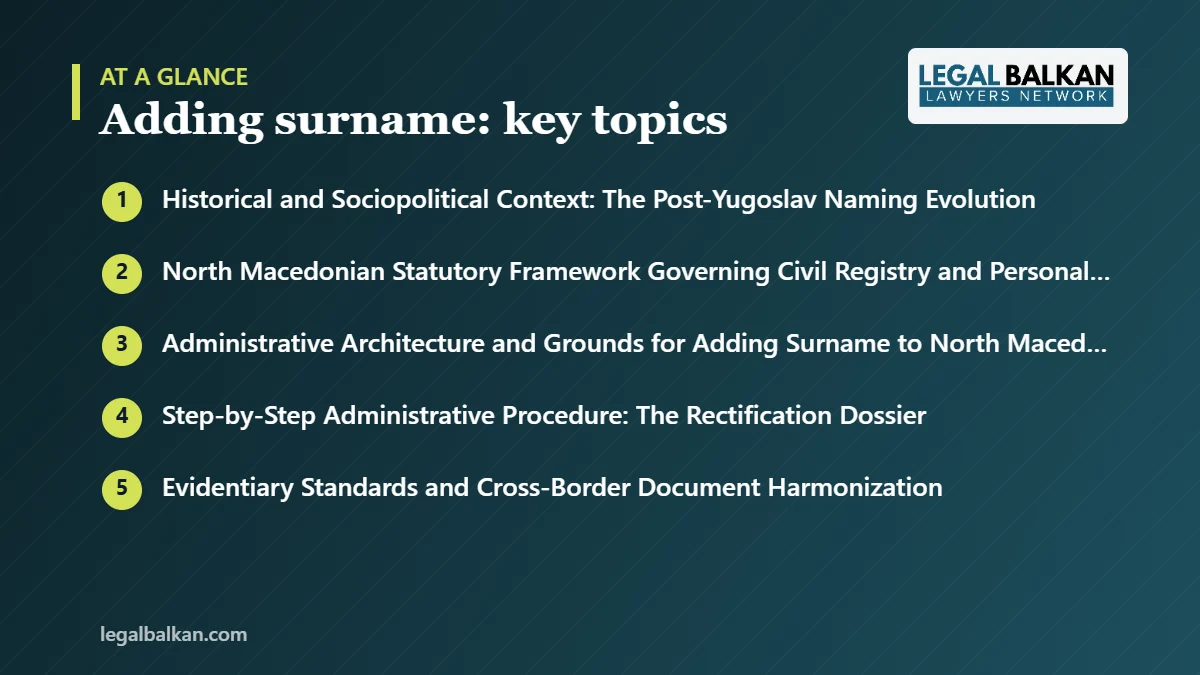
2. North Macedonian Statutory Framework Governing Civil Registry and Personal Names
The procedure for adding, correcting, or amending a surname in North Macedonia is governed by three primary pillars of domestic legislation, reinforced by constitutional rights and international treaties.
A. Zakon za matičnata evidencija (Law on Civil Registry)
The foundational statute governing civil books is the Zakon za matičnata evidencija (Official Gazette of the Republic of Macedonia Nos. 8/1995, 38/2002, 67/2009, 156/2015, and Official Gazette of the Republic of North Macedonia No. 14/2020). The statute prescribes the establishment, maintenance, verification, and amendment of birth, marriage, and death registers.
- Article 4 (Mandatory Registry Data): Mandates that every birth entry in the registry of births (matična kniga na rodenite) must include the child's personal name (given name and surname), sex, exact date, time, and place of birth, as well as the full personal names, citizenship, and residential data of the parents. Where a surname was omitted during the historical entry, the record is legally incomplete.
- Article 11 (Duplicate Registry System): Prescribes that civil registers are maintained in two identical copies: the primary ledger (glavna kniga) held at the local civil registry office, and the secondary duplicate ledger (kontrolna kniga or vtora kniga) deposited with the central administrative archives. When a rectification is executed, both registers must be harmonized and signed by the authorized registrar.
- Articles 23 and 24 (Rectification of Errors and Concluded Ledgers): These articles establish the fundamental boundary between clerical corrections and administrative determinations. Prior to the annual formal closure and certification of the register (which occurs at the end of each calendar year under Article 24), a local registrar may correct obvious clerical errors directly. However, after the register is officially concluded, no correction, addition, or modification may be made except pursuant to a formal administrative Decision (Rešenie) issued by the competent administrative organ.
- Articles 25 and 26 (Subsequent Entry and Supplementation of Data): Regulate the legal mechanism of subsequent entry (dopolnitelen upis) and data supplementation (dopolnuvanje na zapišani podatoci). When facts relating to personal status were not originally entered, an interested party who establishes legitimate legal interest has the statutory right to request a supplementary entry based on authenticated historical evidence.
- Article 34 (Evidentiary Weight of Civil Extracts): Confirms that extracts issued from civil registers (Izvodi) are public documents (javni ispravi) enjoying full statutory evidentiary force (dokazna sila). Their contents are presumed true until proven otherwise through a formal legal procedure.
B. Zakon za ličnoto ime (Law on Personal Name)
The substantive right to bear, determine, and amend a family name is codified in the Zakon za ličnoto ime (Official Gazette of the Republic of Macedonia Nos. 44/1995, 51/2011, and Official Gazette of RNM No. 67/2022). This statute operationalizes the constitutional guarantee of individual identity.
- Article 1 & 2 (Definition and Structure): Article 1 establishes that the personal name is an inalienable personal right of every citizen. Article 2 explicitly states: "The personal name consists of a given name and a surname. Both the given name and the surname may consist of several words." This statutory definition establishes that a birth entry containing solely a given name violates the statutory structure of a personal name under North Macedonian law.
- Article 4 (Surname Determination): Stipulates that children acquire a surname according to parental agreement, taking the surname of one or both parents, or an established family surname. In historical cases where parental surnames were not entered in the birth ledger, Article 4 provides the doctrinal foundation for restoring the ancestral or family surname.
- Articles 8, 9, and 10 (Procedure for Changing or Restoring Names): Governs the formal modification, restoration, or addition of names. While formal voluntary name changes for residing citizens fall under the jurisdiction of the Ministry of Internal Affairs (MVR), the rectification or supplementation of historical birth records for emigrants or individuals whose surnames were omitted at birth is executed via UVMK as a civil status rectification.
C. Zakon za opštata upravna postapka - ZUP (Law on General Administrative Procedure)
The procedural conduct of UVMK is strictly bound by the Zakon za opštata upravna postapka (Official Gazette of the Republic of Macedonia No. 124/2015). Key administrative law principles governing surname rectification include:
- Principle of Material Truth (Article 12 - Načelo na materijalna vistina): The administrative organ is legally mandated to determine the true factual situation of the case and must investigate all relevant facts, including historical and foreign official documents, rather than rejecting petitions on hyper-technical formalities.
- Principle of Hearing the Party (Article 13 - Načelo na soslušuvanje na strankata): Before rendering a decision that denies a requested entry, the organ must provide the applicant an opportunity to comment on the evidentiary findings and submit supplementary proof.
- Statutory Deadlines for Adjudication: Under ZUP, administrative authorities must resolve straightforward applications within 30 days and complex matters requiring archival investigation within a maximum of 60 days.
- Administrative Silence (Molčenje na administracijata): If UVMK fails to render and serve a formal Decision within the statutory period, the applicant is legally entitled to treat the inaction as a tacit refusal and lodge an immediate administrative appeal or court action.
D. Constitutional and European Human Rights Standards
The right to one's name and personal identity is protected under Article 25 of the Constitution of North Macedonia, which guarantees the respect and protection of privacy, personal dignity, and moral integrity. Internationally, this is anchored in Article 8 of the European Convention on Human Rights (ECHR) administered by the Council of Europe (Right to respect for private and family life). The European Court of Human Rights (ECtHR) has repeatedly affirmed in landmark jurisprudence—including Burghartz v.
Switzerland (App. no. 16213/90), Stjerna v. Finland (App. no. 18131/91), and Mentzen v. Latvia (App. no. 71074/01)—that an individual's name is a central element of personal identity and self-determination, and that public authorities must not impose unreasonable obstacles against recognizing legitimate family names. Furthermore, guidelines issued by the United Nations High Commissioner for Refugees (UNHCR) and the Council of Europe emphasize that universal civil registration and legal identity continuity are indispensable human rights.
3. Administrative Architecture and Grounds for Adding Surname to North Macedonia Birth Certificate
Administrative authority over civil records in North Macedonia is concentrated within a dedicated executive agency operating under the supervision of the Ministry of Justice: the Uprava za vodenje na matičnite knigi (UVMK) (uvmk.gov.mk). Understanding the internal organization of UVMK is critical for filing petitions in the correct territorial jurisdiction.
UVMK Organizational Structure and Regional Competence
UVMK exercises its functions through centralized administrative departments in Skopje and a nationwide network of Regional Branches (Podračni oddelenija) and Local Registry Offices (Matični podračja / mesni kancelarii). Territorial jurisdiction is determined by the precise municipality or village where the birth occurred:
Skopje Metropolitan Region
Covers Centar, Čair, Karpoš, Gazi Baba, Kisela Voda, Gjorče Petrov, Butel, Šuto Orizari, Saraj, and Aerodrom. Central repository for diplomatic and consular birth registrations.
Pelagonia & Southwest
Regional branches in Bitola (Manastır), Prilep, Ohrid, Struga, Resen, and Kičevo. Holds extensive early-20th-century Ottoman-transitional Cyrillic registries.
Polog & Northwest
Offices in Tetovo (Kalkandelen) and Gostivar, along with rural mountain registries (Vrapčište, Bogovinje, Mavrovo-Rostuša). High concentration of multilingual archival entries.
Vardar & Eastern Region
Regional branches in Veles (Köprülü), Štip (İştip), Strumica, Kumanovo, Radoviš, Kočani, Kavadarci, and Gevgelija. Central migration departure zones during the 1950s.
For historical records originating prior to 1913 or registers older than 100 years, jurisdiction may intersect with the State Archives of the Republic of North Macedonia (Državen arhiv na Republika Severna Makedonija - DARM) (arhiv.gov.mk). Under the Law on Archival Material, ledgers exceeding the statutory retention period are transferred from UVMK to DARM, requiring specialized archival search protocols before an administrative petition can be framed.
Statutory Mechanisms for Adding Surname to North Macedonia Birth Certificate via UVMK
When petitioning UVMK, counsel must identify the precise legal classification of the request. Submitting a petition under the incorrect statutory heading frequently leads to procedural delays or dismissal. In practice, requests fall into three distinct legal categories:
- Supplementation of Incomplete Entries (Dopolnuvanje na podatoci - Article 25 ZME): Applies where the birth ledger recorded the given name and father's name, but the surname column was left blank or unrecorded. The applicant petitions to supplement the register with the authentic family surname based on historical documentation, ancestral records, or foreign civil status continuity.
- Rectification of Erroneous Entries (Ispravka na greška - Article 23 ZME): Applies where an incorrect surname was entered—such as an unwanted Slavicized suffix (e.g., "-ov" added to an ethnic Turkish name), a phonetically corrupted spelling by a Cyrillic registrar, or an incorrect parental name. The petition seeks to expunge the erroneous spelling and enter the correct statutory surname.
- Subsequent Registration of Legal Surname Determination (Zapišuvanje na naknadno utvrdeno prezime - Article 27 ZME & ZLI): Applies where an individual emigrated abroad, legally acquired a surname in the receiving state under its domestic naturalization laws, and now petitions North Macedonia to harmonize the birth ledger with their internationally recognized legal name.
4. Step-by-Step Administrative Procedure: The Rectification Dossier
The administrative procedure before UVMK requires meticulous procedural execution. As detailed in our comprehensive guide on obtaining documents from official institutions, the process follows five structured stages:
Phase 1: Archival Search and Baseline Extract Retrieval
Before any petition can be submitted, counsel must identify and inspect the original physical birth ledger (matična kniga na rodenite). An official baseline birth extract is issued by UVMK. For complete instructions on locating and retrieving ancestral extracts, consult our specialized guide on obtaining a North Macedonia birth certificate (Izvod na rodeni). This document establishes the exact current state of the ledger, showing the volume number (tom), page number (stranica), entry number (tekovan broj), and the precise textual contents of the personal name and margin notes (zabeleški).
Phase 2: Establishing Active Legal Standing (Aktivna Legitimacija)
Under North Macedonian administrative law, an applicant must demonstrate direct legal interest (praven interes). Standing is established by:
- The registered individual themselves (if living);
- Direct descendants (children, grandchildren) who require the rectification to establish pedigree for citizenship or inheritance;
- Authorized legal attorneys licensed by the Macedonian Bar Association acting pursuant to a specialized, notarized Power of Attorney (Polnomoštno).
Phase 3: Formal Petition Submission (Baranje za Ispravka / Dopolnuvanje)
The formal petition (Baranje) is drafted in the Macedonian language and submitted to the territorial branch of UVMK having jurisdiction over the birth registry. The petition must set forth: (a) the exact historical ledger citations, (b) the precise omitted or erroneous surname, (c) the statutory grounds under Articles 23–26 of the Zakon za matičnata evidencija and Article 2 of the Zakon za ličnoto ime, and (d) an itemized index of authenticated cross-border evidentiary exhibits.
Phase 4: UVMK Evidentiary Review and Verification
Upon receipt, the assigned UVMK inspector (matičar-inspektor) conducts a formal evidentiary inquiry. This involves comparing the primary municipal ledger (glavna kniga) with the secondary control ledger (kontrolna kniga), verifying the authenticity of foreign documents through consular verification channels if necessary, and assessing whether the requested surname addition infringes upon public order or the rights of third parties.
Phase 5: Issuance of Administrative Decision (Rešenie) and Margin Annotation
If the petition is granted, UVMK issues a formal Administrative Decision (Rešenie). This Decision orders the local civil registrar to enter a formal notation in the margin of the original birth ledger (Zabeleška vo rubrikata za zabeleški). The annotation formally records that pursuant to Decision No. [X], the person's surname is supplemented or corrected to [Surname]. Following this annotation, an updated, official Birth Certificate (Izvod od matična kniga na rodenite)—including an international multilingual extract under the 1976 CIEC Convention—is generated reflecting the full legal name and surname.
5. Evidentiary Standards and Cross-Border Document Harmonization
The success of a surname addition petition hinges entirely on the quality and statutory validity of the cross-border evidentiary dossier. Because UVMK inspectors operate under strict administrative liability, they will reject foreign documents that fail to meet statutory authentication standards.
The Turkish Identity Dossier: Core Evidentiary Instruments
For the hundreds of thousands of families who emigrated from North Macedonia to the Republic of Turkey, the evidentiary dossier must bridge the gap between historical Cyrillic registers and modern Turkish civil status records. For a full technical explanation of bilateral civil status harmonization, see our advisory on Balkan Name Equivalence and Civil Registry Rectification. The mandatory components include:
- Name Equivalence Certificate (İsim Denklik Belgesi): Issued by the Turkish Ministry of Interior (NVİ), this document is the single most vital piece of evidence. It officially certifies that "Person X," born in a specified Macedonian village or town under an old Yugoslav name, is identical to "Person Y," who was naturalized in Turkey and assigned a modern Turkish surname. The certificate must explicitly annex the historical migration decree or immigrant card.
- Naturalization Decree (Tabiiyet Kararnamesi): The official decree issued by the Turkish Council of Ministers (Bakanlar Kurulu Kararı) granting Turkish citizenship upon arrival. It records the immigrant's original Yugoslav names, family members, age, and assigned Turkish surname.
- Immigrant Declaration (Muhacir Kağıdı / Vesika): The consular or border clearance certificate issued during emigration, proving legal exit from Yugoslavia.
- Detailed Family Registry Extract (Vukuatlı Nüfus Kayıt Örneği): A complete genealogical extract showing all family connections, marriages, parental lineages, and changes in civil status.
Authentication Regime: Hague Apostille and Sworn Translation
All public documents originating outside North Macedonia must comply with international legalization conventions:
- The 1961 Hague Apostille Convention: Both North Macedonia and Turkey (as well as EU member states, the UK, the US, and Canada) are contracting parties to the Hague Convention Abolishing the Requirement of Legalisation for Foreign Public Documents. Every foreign certificate must bear an original Hague Apostille issued by the competent national authority (e.g., District Governorships / Kaymakamlık in Turkey, Secretaries of State in the US, or the FCDO in the UK). For further technical details, consult our advisory on consular authentication and apostille consultancy.
- Court-Certified Sworn Translation: Under North Macedonian procedural law, foreign documents cannot be submitted in their original language. They must be translated into Macedonian by a court-certified sworn translator (ovlasten sudski preveduvač) registered with the Ministry of Justice of North Macedonia. Translations executed abroad by non-registered translators are routinely rejected by UVMK.
Resolving Orthographic, Toponymic, and Date Discrepancies
A frequent stumbling block in cross-border files is the presence of conflicting biographical data. These include:
- Toponymic Variations: Historical Ottoman town names recorded in Turkish documents must be legally matched to their official modern North Macedonian municipal designations. Common cross-border correspondences include:
- Köprülü → Veles
- Manastır → Bitola
- Üsküp → Skopje
- İştip → Štip
- Kalkandelen → Tetovo
- Gostivar → Gostivar
- Strumica → Strumica
- Debre → Debar
- Kırçova → Kičevo
- Pirlepe → Prilep
- Calendar and Date Discrepancies: Many Turkish documents list artificial birth dates such as 01.07.1935, while the Macedonian ledger records an exact date like 14.04.1935. In such cases, counsel must submit a coordinated petition ensuring that the birth date in the Turkish register is adjusted to match the Macedonian birth record, or vice versa, ensuring complete biographical alignment.
6. Comparative Statutory Matrix: Administrative Track vs. Judicial Track
The following procedural matrix outlines the statutory distinctions between resolving surname additions through the standard UVMK administrative track versus litigating before the Administrative Court of North Macedonia.
| Procedural Dimension | Administrative Track (UVMK) | Judicial Track (Upraven Sud) |
|---|---|---|
| Competent Body | Directorate for Administration of Civil Registers (UVMK Regional Branch) | Administrative Court of North Macedonia (Upraven sud, Skopje) |
| Statutory Legal Basis | Zakon za matičnata evidencija Arts. 23–26; Zakon za ličnoto ime Arts. 1–4 | Zakon za upravnite sporovi; Constitution of RNM Art. 50; ECHR Art. 8 |
| Application Grounds | Omitted surname, clerical error, cross-border name continuity, archival supplementation | Unlawful denial by UVMK, rejection by State Commission, or Administrative Silence |
| Evidentiary Standard | Direct documentary proof: Apostilled civil certificates, certified translations, archival extracts | Review of administrative legality, constitutional proportionality, material truth breach |
| Statutory Processing Deadline | 30 to 60 days under ZUP (often subject to delays without legal counsel) | 6 to 12 months for judicial review and binding ruling |
| Legal Form of Resolution | Administrative Decision (Rešenie) ordering registry margin annotation | Court Judgment (Presuda) annulling the rejection and ordering UVMK compliance |
| Legal Effect on Registers | Registrar enters notation; amended multilingual birth extract issued immediately | Binding judicial command (res judicata); UVMK must execute within 30 days |
| Avenues of Further Appeal | Appeal (Žalba) to State Commission for Second-Instance Administrative Decisions | Appellate review before the Higher Administrative Court (Viš upraven sud) |
7. The Judicial Track: Appeals and Litigation Before the Administrative Court (Upraven Sud)
While the overwhelming majority of surname addition files are successfully resolved through the administrative route when backed by a properly authenticated evidentiary dossier, instances arise where local registry officials issue unlawful refusals or fail to act within statutory deadlines. North Macedonian law provides a robust judicial apparatus to protect applicant rights.
Stage 1: Second-Instance Administrative Appeal (Žalba)
If a local branch of UVMK issues a negative Decision (Rešenie za odbivanje na baranjeto), the applicant has the statutory right under ZUP to lodge an administrative appeal (Žalba) within 15 days of service. The appeal is submitted to the State Commission for Decision-Making in Administrative Procedures and Employment Procedures of the Second Instance (Državna komisija za odlučuvanje vo upravna postapka i postapka od raboten odnos vo vtor stepen) in Skopje.
The appeal must substantiate that the first-instance organ committed procedural violations, failed to determine the material truth, or misapplied substantive provisions of the Zakon za matičnata evidencija and the Zakon za ličnoto ime. The State Commission possesses the legal power to annul the negative decision and remit the case for re-examination with binding instructions, or to reform the decision directly.
Stage 2: Administrative Lawsuit (Tužba za Upraven Spor)
If the State Commission upholds the negative decision, or if it fails to decide on the appeal within 60 days, the applicant is entitled to initiate an administrative lawsuit before the Administrative Court of North Macedonia (Upraven sud na Republika Severna Makedonija), operating under the judicial framework of the Ministry of Justice pursuant to the Law on Administrative Disputes (Zakon za upravnite sporovi).
In the lawsuit, counsel presents constitutional arguments under Article 25 and international protections under Article 8 of the ECHR, asserting that the arbitrary refusal to add an ancestral or naturalized surname constitutes an unlawful interference with the applicant's right to identity and family life. When the Administrative Court finds in favor of the plaintiff, it renders a formal Judgment (Presuda) that quashes the administrative act. Under North Macedonian administrative law, court judgments have mandatory binding force (zadolžitelna pravosilnost), and UVMK is legally compelled to execute the register amendment within 30 days of receiving the judgment.
Remedies for Administrative Silence (Molčenje na Administracijata)
A pervasive issue encountered by foreign applicants is chronic bureaucratic inaction. Registry branches frequently set aside cross-border files for months without issuing a decision. Under Article 89 of ZUP, if an authority fails to issue a decision within 60 days, the applicant must file an administrative reminder. If the authority remains inactive for an additional 7 days, the applicant has an immediate statutory right to lodge an administrative lawsuit for administrative silence directly before the Administrative Court. This legal remedy compels the judiciary to order UVMK to decide the matter or resolves the substantive right directly.
8. Interconnection with North Macedonian Citizenship Restitution (Article 8)
The predominant practical motivation for adding or rectifying a surname on a North Macedonian birth certificate is securing eligibility for citizenship restitution under the Law on Citizenship of the Republic of North Macedonia (Zakon za državljanstvoto na Republika Severna Makedonija). In 2021, the Parliament enacted transformative amendments to Article 8 of the statute, providing:
"An expatriate (emigrant) from the Republic of North Macedonia and their descendant up to the first degree may acquire citizenship of the Republic of North Macedonia by naturalization, even if they do not fulfill the requirements of Article 7, Paragraph 1, Points 2 and 10 of this law."
This provision exempts eligible emigrants and their direct descendants from having to surrender their existing citizenship and waives the requirement of continuous physical residence in North Macedonia. However, the Ministry of Internal Affairs (MVR), which adjudicates citizenship applications, enforces an unyielding evidentiary standard regarding lineage: the biographical data in the foreign applicant's birth and family documents must correspond precisely with the ancestor's civil registry records in North Macedonia.
If an applicant files for citizenship under Article 8 while their ancestor's birth certificate shows only a first name and patronymic (e.g., "Mustafa Ismail"), while the applicant's Turkish documents state the ancestor was named "Mustafa Demir," MVR will immediately issue an administrative suspension order (Prekin na postapka). The applicant is given a strict deadline to reconcile the discrepancies. If the surname addition is not legally completed at UVMK, the citizenship application will be formally rejected. Consequently, adding the surname to the North Macedonian birth certificate is not an optional refinement; it is an absolute legal prerequisite for citizenship acquisition.
9. Strategic Corporate and Succession Implications
Beyond citizenship, rectifying historical birth records plays a critical role in cross-border commercial and private wealth management. Under North Macedonian inheritance law (Zakon za nasleduvanje), legal heirs can only claim ancestral real estate, agricultural parcels, or urban properties if their legal connection to the deceased owner is proven by uninterrupted civil registry entries. When an ancestor emigrated decades ago, title deeds (Imoten list) often reflect old patronymic designations. Harmonizing the birth certificate allows foreign heirs to establish their status before Macedonian probate courts and civil notaries without estate challenges.
Similarly, high-net-worth investors and commercial entities expanding into the Western Balkans frequently leverage ancestral citizenship to establish commercial operations without foreign ownership limitations. Through our corporate practice in cross-border company establishment, clients seamlessly combine civil status restitution with commercial structuring across North Macedonia, Serbia, and Albania.
10. How LegalBalkan Coordinates Cross-Border Registry Rectification
Rectifying historical civil registry records in North Macedonia requires specialized local representation. Because municipal registry offices do not accept informal inquiries and foreign applicants cannot navigate local bureaucratic nuances from abroad, LegalBalkan provides an integrated, end-to-end legal service managed directly by our licensed attorneys in Skopje.
Our Institutional Representation Framework:
- Direct Representation via Special Power of Attorney: Clients are not required to travel to North Macedonia. All procedural steps—from archival searches to administrative hearings—are executed under a specialized legal proxy. Learn more about our procedural workflow on our how we work overview.
- National Archival Research: Our legal team physically inspects municipal ledgers across all regional UVMK branches and conducts deep archival searches at the State Archives (DARM) in Skopje, Bitola, Prilep, Ohrid, and Tetovo.
- Complete Document Legalization and Sworn Translation: We manage the full apostille verification, Hague legalization, and certified Macedonian translations through our network of court-certified sworn interpreters.
- Statutory Petition Drafting & Administrative Advocacy: We prepare meticulously documented petitions under Articles 23–26 of the Zakon za matičnata evidencija, liaising directly with registry inspectors to expedite decision issuance.
- Appellate and Judicial Litigation: In the event of administrative silence or unlawful refusal, our litigation department lodges immediate appeals before the State Commission and represents clients before the Administrative Court of North Macedonia.
- Seamless Citizenship and Business Integration: Following registry rectification, we guide families through subsequent citizenship filings under Article 8, corporate registrations, and estate transfers. Review our full range of cross-border legal services or contact our Skopje office.
11. Frequently Asked Questions (FAQ)
1. Is it legally possible to add a surname to a North Macedonian birth certificate if it was never recorded originally?
Yes. Under Articles 25 and 26 of the Zakon za matičnata evidencija and Article 2 of the Zakon za ličnoto ime, a birth entry that omits a family surname is legally incomplete. An applicant or their authorized descendant has the statutory right to petition UVMK for a supplementary entry (dopolnuvanje na podatoci) to formally register the authentic family surname.
2. Can descendants add a surname to the birth certificate of a deceased ancestor?
Yes. Direct descendants (children, grandchildren) possess active legal standing (aktivna legitimacija) under the Law on General Administrative Procedure (ZUP) because establishing the ancestor's complete legal identity directly impacts the descendant's civil rights, including citizenship restitution under Article 8 and inheritance succession.
3. What role does the Turkish Name Equivalence Certificate (İsim Denklik Belgesi) play in this procedure?
The Name Equivalence Certificate is the primary statutory instrument proving identity continuity across international borders. It certifies that the person born in North Macedonia under a specific Yugoslav name is the exact same individual who naturalized in Turkey with a new surname, linking the historical Cyrillic record directly to modern civil registries.
4. Must foreign documents be apostilled before submission to UVMK?
Yes. All official documents issued outside North Macedonia—including Turkish, European, or American civil status records—must bear an original Hague Apostille certificate pursuant to the 1961 Hague Convention. Documents lacking an Apostille are legally inadmissible under North Macedonian administrative law.
5. Can translations be completed in the applicant's home country?
No. UVMK strictly requires that all translations into the Macedonian language be executed and stamped by a court-certified sworn translator (ovlasten sudski preveduvač) registered with the Ministry of Justice of North Macedonia. Foreign translations are routinely rejected.
6. How long does the administrative procedure take before UVMK?
Under the Law on General Administrative Procedure (ZUP), UVMK is legally bound to render an administrative decision within 30 to 60 days. In practice, cross-border files involving archival cross-referencing take approximately 2 to 4 months when managed by professional local counsel.
7. What happens if UVMK ignores the petition or refuses to issue a decision?
Under Article 89 of ZUP, if UVMK fails to decide within 60 days, the applicant can trigger the doctrine of administrative silence (molčenje na administracijata). After serving a formal warning, counsel can file an appeal with the State Commission and initiate an administrative lawsuit before the Administrative Court to compel compliance.
8. Does adding a surname alter the original historical ledger itself?
No. The original handwritten historical ledger entry is never crossed out or erased. Instead, the civil registrar enters an official marginal note (Zabeleška) citing the UVMK Decision number. All subsequent birth certificates (Izvodi) are issued incorporating the added surname into the primary text.
9. Is the applicant required to travel in person to North Macedonia?
No. The entire procedure can be executed remotely by authorized legal counsel acting under a notarized and apostilled Power of Attorney. LegalBalkan manages the complete filing, document retrieval, and hearing appearances on behalf of international clients.
10. Why is adding the surname essential before submitting a Macedonian citizenship application?
The Ministry of Internal Affairs (MVR) conducts rigorous lineage audits for Article 8 citizenship claims. If the ancestor's birth certificate lacks a surname or differs from the foreign family registry, MVR will suspend or reject the application due to an unverified chain of identity. Adding the surname harmonizes the legal records and guarantees procedural admissibility.
Related Legal Guides
- North Macedonia birth certificate
- North Macedonia citizenship guide
- Apostille and consular legalisation
Have a question about your own case? Contact Legal Balkan for a confidential first assessment.