
Navigating Balkan Customs Regulations Cash and Gold Border Declaration requires strict adherence to statutory thresholds, exchange control mandates, and anti-money laundering frameworks across Southeastern Europe. Crossing international borders in the Western Balkans and Turkey with physical currency, bullion, or valuable movables exposes civilians, investors, and commercial hauliers to severe administrative seizure and criminal prosecution if mandatory customs protocols are overlooked. Through our specialized cross-border legal services, regional transport defense in transportation dispute litigation, and institutional document retrieval via obtaining documents from official institutions, LegalBalkan delivers authoritative statutory counsel for international clients navigating Southeastern European borders.

Table of Contents
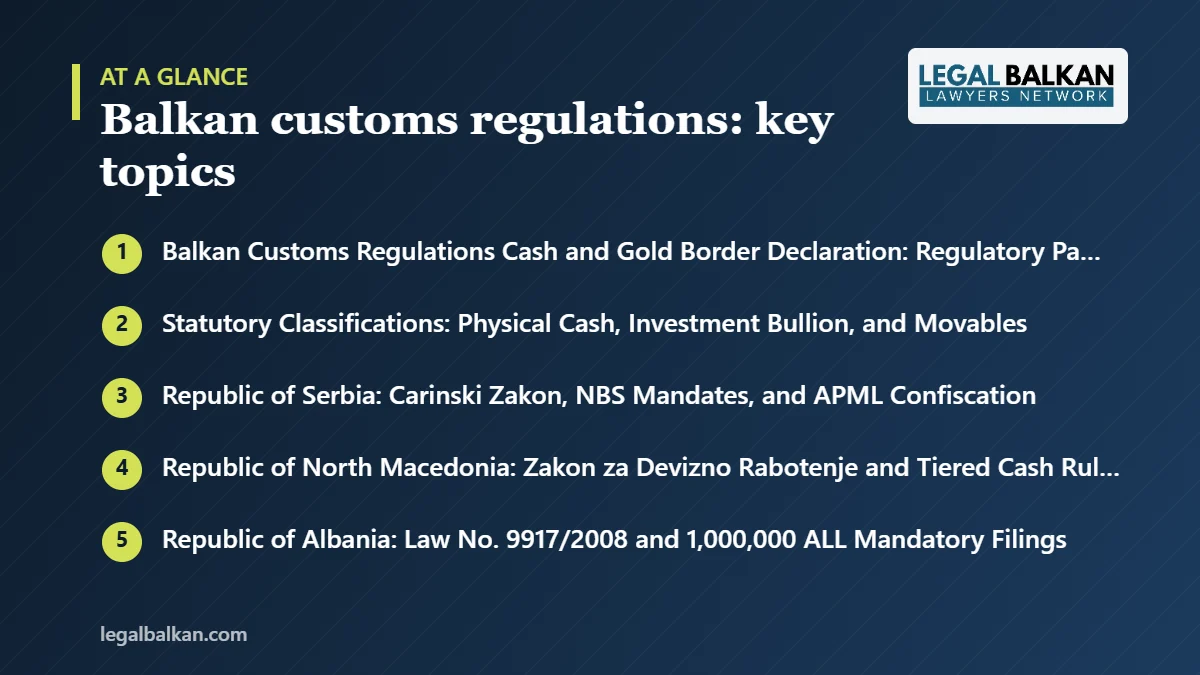
1. Balkan Customs Regulations Cash and Gold Border Declaration: Regulatory Paradigm and Enforcement
The regulatory architecture governing cross-border transfers of physical currency, investment precious metals, and high-value movable assets across the Western Balkans and Turkey represents an intersecting mosaic of national sovereignty, European Union harmonization, and Financial Action Task Force (FATF) anti-money laundering directives. Although candidate countries have aligned substantial portions of their customs acquis with European Union Regulation (EU) 2018/1672 on controls on cash entering or leaving the Union, critical national distinctions persist. These divergences create acute procedural vulnerabilities for international business executives, high-net-worth individuals, diaspora members, and commercial transporters crossing land, air, and maritime checkpoints.
At the core of all regional customs regimes is the fundamental statutory principle: free circulation does not equate to unnotified transit. While the threshold of €10,000 (or its equivalent in national legal tender or convertible foreign currencies) serves as the broad regional benchmark for triggering mandatory disclosure, the precise procedural requirements, permissible deductions, resident versus non-resident treatment, and statutory evidentiary burdens vary significantly between Belgrade, Skopje, Tirana, Prishtina, Sarajevo, Podgorica, and Ankara.
Crucially, customs authorities in Southeastern Europe exercise sweeping administrative powers. A failure to execute a written declaration upon entering or exiting a jurisdiction is classified not merely as a benign clerical irregularity, but as an administrative customs offense (carinski prekršaj / kundërvajtje doganore / gümrük kabahati) that frequently triggers immediate provisional asset seizure, substantial non-refundable financial penalties, and statutory referrals to financial intelligence units (FIUs) and public prosecutor offices for criminal investigation under anti-smuggling and anti-money laundering statutes.
2. Statutory Classifications: Physical Cash, Investment Bullion, and Movables
To accurately apply Balkan customs statutes, travelers and legal counsel must distinguish between three distinct asset categories under regional customs codes and foreign exchange laws:
- Physical Currency and Bearer-Negotiable Instruments: This category encompasses circulating banknotes and coins, traveler’s checks (putnički čekovi / çeqe udhëtimi), promissory notes, bills of exchange, money orders, and signed blank bearer instruments that transfer title upon physical delivery. Digital payment cards or certified bank account balances accessible electronically do not constitute physical cash for border declaration thresholds, provided the physical cards themselves do not contain anonymous stored-value mechanisms.
- Investment Gold and Bullion vs. Personal Jewelry: National statutes draw an absolute distinction between investment gold (investiciono zlato / ar investimi / yatırım altını) and personal jewelry (lični nakit / stoli personale / kişisel ziynet eşyası). Investment gold—defined internationally as gold bars, ingots, plates of high fineness (≥995/1,000), and gold coins minted after 1800 with a fineness of at least 900/1,000 traded at a premium not exceeding 80% over open-market gold value—is strictly regulated as a financial commodity or strategic monetary asset. In several Balkan jurisdictions, natural persons are entirely prohibited from transporting investment bullion across the border without commercial licenses and central bank permits. Conversely, personal jewelry worn or carried in luggage is exempt from declaration only if its quantity, variety, and value reasonably correspond to personal use and the traveler’s personal circumstances during travel.
- High-Value Movable Assets and Non-Commercial Baggage: Movable chattels, including luxury timepieces, specialized professional cinematic or technical gear, high-end electronics, musical instruments, and commercial samples, are governed by personal luggage duty-free thresholds (€100 to €430 depending on nationality, travel mode, and destination). Any movable goods carried for commercial trade, resale, or professional exhibition must be declared under formal temporary admission procedures (such as an ATA Carnet – karnet ATA) or standard import declarations.
3. Republic of Serbia: Carinski Zakon, NBS Mandates, and APML Confiscation
The Republic of Serbia maintains one of the most rigorously enforced currency and customs control frameworks in Southeastern Europe. Border operations conducted by the Customs Administration of the Republic of Serbia (Uprava carina Republike Srbije – carina.rs) at high-volume border crossings such as Gradina (Bulgaria), Horgoš and Kelebija (Hungary), Batrovci (Croatia), and Belgrade Nikola Tesla Airport are characterized by stringent physical inspections and immediate asset freezing.
Balkan Customs Regulations Cash and Gold Border Declaration: Serbian Statutory Foundation
Governing Legislation: Carinski zakon (Official Gazette of RS Nos. 95/2018, 91/2019, 144/2020); Zakon o deviznom poslovanju (Official Gazette of RS Nos. 62/2006, 31/2011, 119/2012, 139/2014, 30/2018); Zakon o sprečavanju pranja novca i finansiranja terorizma (Official Gazette of RS Nos. 113/2017, 91/2019, 153/2020, 26/2023); National Bank of Serbia (NBS – Narodna banka Srbije) Decision on Conditions for Transferring Means of Payment Abroad and into Serbia.
Enforcement Authorities: Uprava carina, Administration for the Prevention of Money Laundering (APML – Uprava za sprečavanje pranja novca), and the Higher Public Prosecutor’s Office (Special Anti-Corruption Department).
Physical Cash and Foreign Currency Rules in Serbia
Under Serbian foreign exchange regulations, physical transfer of cash into the Republic of Serbia is legally unlimited in volume; however, any amount equal to or exceeding €10,000 (or its counter-value in Serbian Dinars – RSD or other foreign currencies) must be explicitly declared in writing to customs officers upon entry using the official Cash Declaration Form (Obrazac prijave prenosa fizički prenosivih sredstava plaćanja). The customs officer certifies the declaration and issues an official receipt (Potvrda o unetim sredstvima plaćanja). This certified confirmation is indispensable: it remains legally valid for up to three years and constitutes the sole conclusive evidence permitting a non-resident to re-export remaining cash upon exiting Serbia.
Regarding cash export (taking funds out of Serbia), statutory rules draw a fundamental distinction between residents and non-residents:
- Serbian Residents (Citizens and Permanent Domiciliaries): May freely export up to €10,000 in cash without documentation. Exporting amounts exceeding €10,000 is legally prohibited for residents, subject only to strict, exhaustively enumerated statutory exemptions: (i) permanent emigration abroad, requiring documented proof of an emigration visa, foreign permanent residence permit, and deregistration from the Serbian tax registry; or (ii) documented foreign business assignments, requiring formal corporate travel orders and commercial invoices.
- Non-Residents: May freely export up to €10,000 without documentation. Non-residents may export cash exceeding €10,000 only if they present one of the following authentic documents to customs upon departure:
- The certified Customs Declaration Certificate issued upon previous entry into Serbia (Potvrda o unošenju gotovine);
- A certified bank certificate (Potvrda ovlašćene banke) confirming that the cash was withdrawn from the non-resident’s personal foreign currency account held at a licensed bank in Serbia; or
- A certified exchange office receipt (Potvrda ovlašćenog menjača) proving that dinars withdrawn from an international payment card through a domestic bank or ATM were converted into foreign currency.
Investment Gold, Bullion, and Personal Jewelry in Serbia
Investment gold (investiciono zlato), gold coins (zlatnici), and unprocessed precious metals are classified under Serbian law as capital foreign exchange assets. Civilians and natural persons are not permitted to freely transport gold bullion across the state border. Commercial import or export of gold bars and bullion requires advance authorization and licenses from the Ministry of Domestic and Foreign Trade (Ministarstvo unutrašnje i spoljne trgovine) and notification to the National Bank of Serbia.
Personal jewelry (lični nakit) worn on the person or packed in personal luggage is permissible without duty provided it is customary for personal adornment. However, if a traveler transports valuable jewelry collections, unmounted gems, or identical jewelry pieces indicating commercial intent, these items must be declared on the customs form upon entering Serbia. Failure to declare creates an immediate statutory presumption of illicit commercial importation or customs smuggling (krijumčarenje).
Personal Luggage and Non-Commercial Goods Exemptions in Serbia
For Serbian domestic residents returning from abroad, the duty-free allowance for non-commercial personal goods imported in accompanied luggage is limited to €100 in total value. For foreign non-residents entering Serbia, accompanied personal luggage consisting of clothing, toiletries, and portable personal equipment intended for personal use during their temporary stay is admitted duty-free under temporary admission rules (Article 216 of Carinski zakon). Commercial merchandise, high-value professional equipment, or unaccompanied goods must be formally declared at the red customs channel.
4. Republic of North Macedonia: Zakon za Devizno Rabotenje and Tiered Cash Rules
In the Republic of North Macedonia, border customs controls and currency surveillance are exercised by the Customs Administration of North Macedonia (Carinska uprava na Republika Severna Makedonija – customs.gov.mk). The statutory regime establishes a distinctive, tiered structure for cash export that imposes stricter requirements on domestic residents than many other regional states.
North Macedonian Statutory Foundation
Governing Legislation: Zakon za devizno rabotenje (Law on Foreign Exchange Operations, Official Gazette of RM Nos. 34/2001, 49/2001, 103/2001, 51/2003, 81/2008, 24/2011, 135/2011, 188/2013, 97/2015, 153/2015, 23/2016); Carinski zakon (Official Gazette of RM Nos. 39/2005 ... 248/2020); Zakon za sprečuvanje na perenje pari i finansiranje na terorizam (Official Gazette of RNM No. 151/2022); National Bank of the Republic of North Macedonia (NBRNM – Narodna banka na Republika Severna Makedonija) regulations.
Enforcement Authorities: Carinska uprava, Financial Intelligence Authority (Uprava za finansisko razuznavanje – UFR), and Basic Public Prosecutor’s Office.
Physical Currency Import and Tiered Export Controls in North Macedonia
Importing physical currency into North Macedonia is unrestricted in amount; however, all cash, payment instruments, or checks equal to or exceeding €10,000 (or equivalent in foreign currency or Macedonian Denars – MKD) must be declared in writing at the border crossing point using the official cash declaration form (Prijava na vnesuvanje/iznesuvanje na gotovi pari i čekovi). Customs issues an authenticated certificate (Potvrda za prijava na stranski pari pri vlez).
When leaving North Macedonia, the statutory framework enforces rigorous restrictions based on residency:
- Macedonian Residents (Natural Persons):
- May freely take out up to €2,000 (or equivalent in foreign currency) without any documentation or declaration.
- For amounts between €2,000 and €10,000: The resident must present a formal certificate from an authorized commercial bank (potvrda od ovlastena banka) or an authorized exchange office (potvrda od menuvačnica) proving lawful acquisition or withdrawal of the funds, and execute a customs declaration.
- Amounts exceeding €10,000: Resident natural persons are legally barred from exporting cash exceeding €10,000, except under extraordinary statutory authorizations approved by the National Bank (NBRNM).
- Non-Residents (Foreign Nationals and Non-Domiciliaries):
- May freely export cash up to €10,000 without documentation.
- To export amounts exceeding €10,000: The non-resident must present the authenticated entry customs certificate (Potvrda za prijavena gotovina pri vlez) proving the funds were previously declared upon arrival, or an official bank withdrawal slip from a licensed Macedonian bank showing that funds were legitimately disbursed from a non-resident bank account.
Investment Gold, Bullion, and Movables in North Macedonia
Investment gold (investiciono zlato), unrefined bullion, and commercial precious metals are subject to foreign trade regulation. Physical movement of investment gold across the border by natural persons without a formal foreign trade license issued by the Ministry of Economy (Ministerstvo za ekonomija) and clearance through Carinska uprava is strictly prohibited. Unofficial importation or exportation is prosecuted as contraband.
Personal jewelry (ličen nakit) for personal use is duty-free; however, high-value items or pieces carried in quantity must be declared upon entry. For accompanied personal luggage of returning domestic residents, goods up to €350 are admitted duty-free. Professional equipment or commercial samples require an ATA Carnet (karnet ATA) or formal temporary importation bonds.
5. Republic of Albania: Law No. 9917/2008 and 1,000,000 ALL Mandatory Filings
The Republic of Albania operates a statutory cash control regime overseen by the General Directorate of Customs (Drejtoria e Përgjithshme e Doganave – dogana.gov.al) in close coordination with the General Directorate for the Prevention of Money Laundering (DPPPP – Drejtoria e Përgjithshme e Parandalimit të Pastrimit të Parave). Albania’s currency threshold is set in national currency (Albanian Lek – ALL), establishing a specific statutory trigger.
Albanian Statutory Foundation
Governing Legislation: Kodi Doganor i Republikës së Shqipërisë (Law No. 102/2014, as amended); Ligji Nr. 9917, datë 19.5.2008 “Për parandalimin e pastrimit të parave dhe financimit të terrorizmit” (as amended by Laws No. 10391/2011, 66/2012, 44/2017, 33/2019); Decisions of the Council of Ministers (VKM); Bank of Albania (Banka e Shqipërisë) regulations.
Enforcement Authorities: Drejtoria e Përgjithshme e Doganave, DPPPP (Financial Intelligence Unit), and the Special Prosecution Against Corruption and Organized Crime (SPAK – Struktura e Posaçme Kundër Korrupsionit dhe Krimit të Organizuar).
Mandatory Declaration Rules: The 1,000,000 ALL Threshold
Under Article 17 of Albanian Law No. 9917/2008 and customs implementing provisions, any person (resident or non-resident) entering or exiting the territory of the Republic of Albania carrying physical cash, bearer negotiable instruments (instrumente të negociueshme me prurës), or precious metals and stones exceeding 1,000,000 ALL (approximately €10,000 equivalent) is legally bound to declare them in writing to the customs authority on the official Cash and Valuables Declaration Form (Formulari i Deklarimit të Parave dhe Sendeve me Vlerë).
Unlike some jurisdictions that differentiate between entry and exit or resident status, the Albanian declaration obligation applies universally to all natural persons crossing the frontier. The declaration requires travelers to state the exact sum, currency, source of funds, lawful ownership, recipient, and economic purpose of the cross-border movement.
Precious Metals, Gold Bullion, and Movables in Albania
Commercial precious metals, raw gold, and investment bullion (ar investimi) transported across Albanian borders require formal commercial declarations, fiscal invoices, and compliance with Bank of Albania standards. Uncoined gold cannot be transported as personal effects. Personal jewelry (stoli personale) worn in standard quantities is exempt, but valuable collections exceeding personal travel adornment must be documented on the declaration form.
Non-commercial luggage exemptions for goods in passenger baggage are set at €300 for travelers arriving via land borders, and €430 for passengers arriving via air or sea ports (with an exemption limit of €150 for minors under 15 years).
6. Republic of Kosovo: Law No. 05/L-096 and Dogana e Kosovës Controls
The Republic of Kosovo enforces strict customs and anti-money laundering controls at all international border crossing points (including Prishtina International Airport Adem Jashari, Merdare, Vërmicë, Hani i Elezit, Dheu i Bardhë, and Jarinje) via Kosovo Customs (Dogana e Kosovës – dogana.rks-gov.net).
Kosovo Statutory Foundation
Governing Legislation: Kodi Doganor dhe i Akcizave të Kosovës (Customs and Excise Code No. 03/L-109, as amended); Ligji Nr. 05/L-096 për parandalimin e pastrimit të parave dhe luftimin e financimit të terrorizmit (Law No. 05/L-096); Administrative Instructions of the Ministry of Finance, Labor and Transfers.
Enforcement Authorities: Dogana e Kosovës, Financial Intelligence Unit of Kosovo (NJIFK – Njësia e Inteligjencës Financiare e Kosovës), and the Special Prosecution Office of the Republic of Kosovo (PSRK – Prokuroria Speciale e Republikës së Kosovës).
Mandatory Cash Declaration at Kosovo Borders
Under Article 33 of Law No. 05/L-096, any natural person entering or leaving the customs territory of the Republic of Kosovo carrying physical cash, checks, or bearer negotiable instruments in the amount of €10,000 or more (in Euros or equivalent in foreign currencies) is legally obligated to declare it in writing to Kosovo Customs using the Cash Declaration Form (Deklarata për bartjen e parave të gatshme).
The threshold applies equally to residents and non-residents, on entry and exit. The declaration requires precise disclosure of the origin of the funds, the economic owner, the prospective recipient, and the specific intended commercial or personal transaction.
Gold, Precious Commodities, and Luggage Limits in Kosovo
Investment gold bars, ingots, and unminted bullion are classified as commercial goods subject to formal customs declarations, import clearance, payment of 18% Value Added Tax (VAT), and applicable customs duties. They cannot be carried through passenger channels without authorization. Personal jewelry (stoli personale) worn by the traveler is exempt provided its volume does not exceed normal personal adornment.
Duty-free allowances for goods in personal accompanied luggage are set at €300 for land borders and €430 for air travel (or €175 for passengers under 15 years of age). High-value equipment carried by commercial entities or media professionals requires an ATA Carnet or security deposit.
7. Bosnia and Herzegovina: UIO BiH Oversight and Entity Currency Regimes
In Bosnia and Herzegovina (BiH), customs borders and indirect taxation are administered exclusively at the state level by the Indirect Taxation Authority of BiH (Uprava za indirektno oporezivanje BiH – UIO / UNO – uino.gov.ba). However, foreign exchange operations and internal banking regulations are divided between the two administrative entities: the Federation of Bosnia and Herzegovina (FBiH) and the Republika Srpska (RS).
Bosnia and Herzegovina Statutory Foundation
Governing Legislation: Zakon o carinskoj politici Bosne i Hercegovine (Official Gazette of BiH No. 58/15); Zakon o carinskim prekršajima Bosne i Hercegovine (Official Gazette of BiH Nos. 88/05, 54/10); Zakon o sprječavanju pranja novca i finansiranja terorističkih aktivnosti (Official Gazette of BiH No. 13/2024 – newly enacted comprehensive AML statute); Entity foreign exchange laws (FBiH Official Gazette Nos. 35/98, 102/24; RS Official Gazette Nos. 96/03 ... 20/18); Central Bank of Bosnia and Herzegovina (CBBH) decisions.
Enforcement Authorities: Uprava za indirektno oporezivanje (UIO BiH), State Investigation and Protection Agency – Financial Intelligence Department (SIPA-FOO – Finansijsko-obavještajni odjel), and the Prosecutor’s Office of BiH (Tužilaštvo BiH).
Cash Declaration Controls at BiH Borders
Any civilian or commercial traveler entering or leaving Bosnia and Herzegovina who carries physical cash, checks, or bearer negotiable securities equal to or exceeding €10,000 (or the statutory equivalent of 20,000 BAM – Convertible Marks / Konvertibilna marka) must declare it in writing to the UIO customs officer at the border crossing point using the official Cash Declaration Form (Prijava gotovinskih sredstava).
Entity foreign exchange regulations impose specific restrictions on cash export:
- BiH Residents: May freely export cash up to €10,000 / 20,000 BAM. Exporting sums exceeding €10,000 is prohibited without formal central banking permits or verified documentation proving permissible statutory capital transfers abroad.
- Non-Residents: May freely export up to €10,000 / 20,000 BAM. Exporting cash exceeding this threshold requires presentation of the certified UIO entry receipt (Potvrda o prijavi gotovine pri ulasku) or a bank withdrawal receipt confirming disbursement from a non-resident bank account in a licensed commercial bank within BiH.
Gold, Precious Metals, and Baggage Rules in BiH
Investment gold (ingots, bars, minted coins) is classified as a regulated financial and trade commodity. Unofficial cross-border transport of gold bullion by natural persons is strictly illegal and subject to criminal smuggling charges. Commercial imports require authorization and are subject to 17% VAT and customs duties. Personal jewelry (lični nakit) is exempt provided it is worn or carried within personal reasonable limits.
The duty-free allowance for non-commercial personal goods imported in accompanied passenger luggage into BiH is set at 600 BAM (approximately €300) per adult traveler. Goods exceeding this limit must be processed through standard customs clearance.
8. Montenegro: Carinski Zakon and 2023 Anti-Money Laundering Framework
Montenegro, having unilaterally adopted the Euro as its de facto legal tender, enforces customs border procedures through the Revenue and Customs Administration of Montenegro (Uprava carina Crne Gore – gov.me/carina). The Montenegrin statutory framework underwent comprehensive modernization with the entry into force of the landmark Zakon o sprječavanju pranja novca i finansiranja terorizma in late 2023, harmonizing national border controls directly with EU Regulation 2018/1672.
Montenegrin Statutory Foundation
Governing Legislation: Carinski zakon (Official Gazette of Montenegro No. 145/2021); Zakon o sprječavanju pranja novca i finansiranja terorizma (Official Gazette of Montenegro No. 110/2023); Zakon o tekućim i kapitalnim poslovima sa inostranstvom (Official Gazette of Montenegro Nos. 45/2005 ... 70/2017); Central Bank of Montenegro (CBCG – Centralna banka Crne Gore) decisions; Zakon o prekršajima (Official Gazette Nos. 1/2011 ... 152/2022).
Enforcement Authorities: Uprava carina, Financial Intelligence Sector of the Police Directorate (SFOP – Sektor za finansijsko-obavještajne poslove), and the Special State Prosecutor’s Office (SDT – Specijalno državno tužilaštvo).
Cash Declaration Requirements in Montenegro
Under Article 104 and 105 of the Montenegrin AML Law No. 110/2023, every domestic or foreign traveler entering or leaving Montenegro who carries physical cash, bearer checks, or negotiable payment instruments equal to or exceeding €10,000 must declare it in writing to the customs authority using the Cash Declaration Form (Obrazac za prijavu gotovog novca).
Residents may freely transfer cash up to €10,000; exporting cash over €10,000 requires documented justification (such as capital investment abroad or emigration, supported by central bank filings and bank confirmations). Non-residents may export cash exceeding €10,000 provided they produce either the certified customs entry declaration certificate (Potvrda Uprave carina o unošenju gotovog novca) or an authenticated certificate from a licensed commercial bank in Montenegro confirming lawful withdrawal.
Investment Gold, Bullion, and Baggage Limits in Montenegro
Investment gold bars, ingots, and unminted bullion must be formally declared through commercial customs channels. Civilian travelers cannot carry bullion across borders without commercial invoices, origin documentation, and foreign trade clearance. Personal jewelry (lični nakit) is exempt if reasonable for personal wear during travel.
The duty-free allowance for non-commercial personal luggage is €300 for passengers arriving via land frontiers and €430 for maritime and air passengers (with a €150 exemption for minors under 15 years).
9. Republic of Türkiye: Decree No. 32, BIST Bullion Monopoly, and MASAK Scrutiny
The Republic of Türkiye operates an asymmetric customs and currency regime governed by the Ministry of Trade (T.C. Ticaret Bakanlığı – ticaret.gov.tr), Directorate General of Customs, and the Financial Crimes Investigation Board (MASAK – Mali Suçları Araştırma Kurulu – masak.gov.tr). Turkey’s legal framework is distinguished by completely unrestricted entry of foreign currency, coupled with exceptionally strict statutory export controls and a state-enforced institutional monopoly over investment gold bullion.
Turkish Statutory Foundation
Governing Legislation: Türk Parası Kıymetini Koruma Hakkında 32 Sayılı Karar (Decree No. 32 on the Protection of the Value of Turkish Currency, dated 7/7/1989 as amended); Communiqué No. 2008-32/34 on Decree No. 32; 4458 sayılı Gümrük Kanunu (Customs Law No. 4458); 5549 sayılı Suç Gelirlerinin Aklanmasının Önlenmesi Hakkında Kanun (Law No. 5549); 5607 sayılı Kaçakçılıkla Mücadele Kanunu (Anti-Smuggling Law No. 5607); Central Bank of the Republic of Turkey (TCMB – tcmb.gov.tr) regulations.
Enforcement Authorities: Ministry of Trade – Customs Enforcement Directorate (Gümrük Muhafaza Kaçakçılık ve İstihbarat Müdürlüğü), MASAK, and Chief Public Prosecutor Offices (Cumhuriyet Başsavcılığı).
Asymmetric Cash Entry vs. Exit Rules in Türkiye
The Turkish currency framework establishes two diametrically opposed regimes for entry and exit:
- Import / Entry of Cash (Yurda Nakit Girişi): The introduction of foreign currency or Turkish Lira into Türkiye is completely free and unrestricted in amount without payment of import taxes or duties. Travelers are not legally compelled to declare incoming cash; however, travelers carrying substantial cash are strongly advised to voluntarily request an official Cash Entry Declaration Form (Nakit Giriş Beyan Formu) from customs. This stamped document provides indispensable statutory proof of lawful origin if the traveler subsequently seeks to take unused cash out of Turkey, deposit funds into a Turkish bank, or execute commercial or real estate purchases without triggering mandatory MASAK suspicious transaction audits.
- Export / Exit of Cash (Yurttan Nakit Çıkışı): Strict statutory caps apply:
- Turkish Lira (TRY): Travelers may freely export up to 25,000 TRY. Any export of Turkish Lira exceeding 25,000 TRY is strictly prohibited unless processed through authorized commercial banks or declared with official origin documentation.
- Foreign Currency: Travelers may freely export up to €10,000 or $10,000 USD (or equivalent).
- Exporting foreign currency exceeding €10,000 / $10,000: Natural persons must complete the official Cash Exit Declaration Form (Nakit Çıkış Beyan Formu) before passing customs control. Crucially, under Turkish currency regulations, the traveler must substantiate lawful origin by presenting either: (i) an authentic bank withdrawal certificate from a Turkish licensed bank showing recent withdrawal; or (ii) the certified Nakit Giriş Beyan Formu establishing that the funds were imported on a prior entry.
Institutional Bullion Monopoly and Personal Jewelry Caps in Türkiye
Turkey enforces one of the world’s most restrictive legal frameworks regarding physical bullion:
- Personal Jewelry (Kişisel Ziynet Eşyası): Travelers may transport personal jewelry made of precious metals and stones into and out of Turkey duty-free, provided its total value does not exceed $15,000 USD (or equivalent) and it is intended solely for personal, non-commercial adornment. Jewelry exceeding $15,000 must be declared upon entry to guarantee that it can be re-exported without being treated as an illegal commercial export.
- Investment Gold Bullion (Külçe Altın ve Standart Dışı İşlenmemiş Altın): Natural persons and civilian travelers are ABSOLUTELY PROHIBITED from carrying gold bullion, bars, ingots, scrap gold, or commercial quantities across Turkish borders. Under Decree No. 32 and Ministry of Trade communiqués, the import and export of unprocessed gold and investment bullion is an exclusive statutory monopoly reserved for the Central Bank of the Republic of Turkey (TCMB) and Precious Metals Intermediary Institutions (Kıymetli Maden Aracı Kuruluşları) registered with the Borsa Istanbul (BIST) Precious Metals and Diamond Market. Any attempt by a civilian traveler to transport gold bars, ingots, or commercial bullion constitutes an aggravated smuggling offense under Anti-Smuggling Law No. 5607.
10. Balkan Customs Regulations Cash and Gold Border Declaration: 7-Jurisdiction Comparative Matrix Table
The following structured matrix compares cross-border customs declarations, cash thresholds, gold bullion regulations, baggage exemptions, high-value movables, and non-declaration penalties across all seven jurisdictions:
| Jurisdiction | Governing Customs & Currency Laws | Free Cash Threshold (Residents vs. Non-Residents) | Gold Bullion & Personal Jewelry Rules | Duty-Free Luggage & Movables Limits | Non-Declaration Penalties & Seizure Powers | Competent Customs & FIU Authorities |
|---|---|---|---|---|---|---|
| Republic of Serbia | Carinski zakon; Zakon o deviznom poslovanju; NBS Decision on Cash Transfers. | €10,000. Entry: Declare ≥€10,000. Exit: Residents max €10,000 (exceptions for emigration/business). Non-residents over €10,000 require entry receipt or bank withdrawal slip. | Investment gold/bars strictly prohibited for civilian transit without trade license. Personal jewelry allowed within reasonable personal wear. | €100 for domestic returning residents; temporary admission for foreign non-residents. Commercial movables require ATA Carnet. | Provisional seizure of excess cash/goods; fines from 20% to 100%; permanent confiscation; criminal charges under Art. 230/245 CC. | Uprava carina (carina.rs), APML, Prekršajni sud. |
| North Macedonia | Zakon za devizno rabotenje; Carinski zakon; NBRNM Regulations. | Entry: Declare ≥€10,000. Exit: Residents up to €2,000 free; €2,000–€10,000 requires bank/exchange slip; >€10,000 prohibited. Non-residents >€10,000 requires entry declaration or bank slip. | Bullion requires Ministry of Economy trade permits. Personal jewelry exempt within personal wear; high-value sets must be declared. | €350 for domestic travelers; temporary admission for non-residents. Samples require Karnet ATA. | Immediate seizure of undeclared funds/commodities; misdemeanor fines; state budget forfeiture; criminal referral to UFR and Prosecution. | Carinska uprava (customs.gov.mk), UFR, Basic Courts. |
| Republic of Albania | Kodi Doganor; Law No. 9917/2008 on AML/CFT (Art. 17); VKM Decisions. | 1,000,000 ALL (~€10,000). Universal declaration for all travelers on entry and exit exceeding threshold. | Precious metals >1,000,000 ALL must be declared. Bullion requires commercial import licenses. Personal jewelry allowed within reasonable limits. | €300 land border, €430 air/sea ports (€150 for minors <15). Professional goods under temporary admission. | Seizure; tiered fines under Law 9917: 20% (1M–2M ALL), 30% (2M–5M ALL), 40% (≥5M ALL); DPPPP / SPAK criminal referral. | Drejtoria e Doganave (dogana.gov.al), DPPPP, SPAK. |
| Republic of Kosovo | Kodi Doganor dhe i Akcizave; Law No. 05/L-096 on AML/CFT (Art. 33). | €10,000. Mandatory written declaration on entry and exit for any sum ≥€10,000 (residents and non-residents alike). | Bullion classified as commercial goods; subject to 18% VAT and clearance. Personal jewelry exempt within personal wear limits. | €300 land border, €430 air arrivals (€175 for minors <15). High-value equipment requires ATA Carnet or cash bond. | Temporary seizure; mandatory administrative fine of 25% of carried sum; investigation by NJIFK and PSRK; court forfeiture. | Dogana e Kosovës (dogana.rks-gov.net), NJIFK, PSRK. |
| Bosnia & Herzegovina | Zakon o carinskoj politici BiH; Law on AML/CFT No. 13/2024; Entity FX Laws. | €10,000 / 20,000 BAM. Entry: Declare ≥€10,000. Exit: Residents max €10,000 without FX permit. Non-residents over €10,000 require entry slip or bank receipt. | Bullion transit prohibited for civilians; commercial imports require license, origin certificate, 17% VAT. Personal jewelry allowed. | 600 BAM (~€300) per traveler in accompanied passenger baggage. Commercial samples require ATA carnet. | Provisional seizure; misdemeanor fines 20% to 100%; judicial forfeiture; SIPA-FOO and State Prosecutor referral. | UIO BiH (uino.gov.ba), SIPA-FOO, Tužilaštvo BiH. |
| Montenegro | Carinski zakon; Zakon o sprječavanju pranja novca (Official Gazette 110/2023). | €10,000. Entry: Declare ≥€10,000. Exit: Residents max €10,000 (statutory exemptions apply). Non-residents >€10,000 requires entry declaration or bank slip. | Investment gold treated as financial/commercial asset; requires trade clearance. Personal jewelry exempt within personal wear. | €300 land border, €430 air/maritime (€150 for minors <15). Professional equipment under temporary admission. | Administrative seizure; fines €500 to €20,000 or 10%–50% of funds; mandatory confiscation; SFOP and SDT criminal referral. | Uprava carina (gov.me/carina), SFOP, Sud za prekršaje. |
| Republic of Türkiye | Decree No. 32; Customs Law No. 4458; Law No. 5549; Anti-Smuggling Law No. 5607. | Entry: Completely free and tax-free (voluntary declaration). Exit: Max 25,000 TRY or €10,000 / $10,000 USD. Excess requires declaration and bank/entry slip. | Personal jewelry max $15,000 USD. Investment bullion transit by civilians STRICTLY PROHIBITED (BIST/TCMB monopoly). Smuggling offense. | €430 per passenger aged ≥15; €150 for passengers <15. Commercial samples under ATA Carnet. | Administrative detention/seizure; fines 20% to 100% under Law 5549; criminal charges under Law 5607 (1–5 yrs prison) and forfeiture. | Ticaret Bakanlığı (ticaret.gov.tr), MASAK, Savcılık. |
11. High-Value Movables, Luxury Timepieces, Motor Vehicles, and Temporary Admission (Karnet ATA / Privremeni Uvoz)
Beyond physical currency and investment bullion, cross-border traveler transit across the Western Balkans and Turkey frequently involves high-value movable assets (pokretne stvari / sendet e luajtshme / menkul mallar), luxury timepieces, expensive computing and audio-visual electronics, commercial trade samples, and passenger motor vehicles. Customs authorities across Southeastern Europe enforce stringent statutory presumptions of commercial intent whenever goods carried in passenger vehicles or accompanied baggage exceed statutory personal luggage limits.
Luxury Timepieces, High-End Electronics, and the Presumption of Commercial Importation
Under regional customs legislation, passengers frequently incur severe customs offenses by purchasing luxury watches (e.g., Rolex, Audemars Piguet, Patek Philippe, Cartier) or high-end electronics (such as MacBook Pro workstations, professional cinema cameras, or commercial drones) abroad and attempting to transport them across borders without written declaration. Customs officers systematically scan luggage and inspect vehicles for:
- Intact Manufacturer Packaging and Retail Tags: Carrying original presentation boxes, warranty booklets, serial number certificates, or sales receipts inside luggage while wearing the watch or carrying the electronics establishes a prima facie presumption of illicit commercial importation or tax fraud (especially when export VAT refund stamps, such as Global Blue or Tax-Free slips, have been stamped at the departing border).
- Multiplicity of Identical Goods: Transporting more than one unit of high-value electronic equipment (e.g., multiple smartphones or laptops in original packaging) automatically strips the traveler of the non-commercial passenger allowance (€100 in Serbia, €300/€430 in Albania, Kosovo, North Macedonia, Montenegro, and Turkey).
- Statutory Sanctions: In Serbia, North Macedonia, and Montenegro, undeclared luxury timepieces and electronics are immediately seized provisionally (privremeno oduzimanje robe). The traveler is subjected to misdemeanor proceedings resulting in mandatory customs duty (typically 5%–10%), national VAT (17% to 20%), plus punitive fines ranging from 50% to 100% of the customs value, or absolute forfeiture to the state treasury. In Turkey, undeclared commercial electronics and luxury watches trigger criminal investigations under Anti-Smuggling Law No. 5607 (Kaçakçılıkla Mücadele Kanunu).
Motor Vehicles with Foreign License Plates and Temporary Admission (Privremeni Uvoz Motornih Vozila)
One of the most catastrophic customs pitfalls in the Western Balkans involves motor vehicles. Strict residency-based customs regimes govern the temporary admission of motor vehicles bearing foreign license plates:
- The Resident Driving Prohibition: Under Serbian Carinski zakon, North Macedonian customs law, Albanian customs code, and Turkish customs legislation, a domestic resident of the country is STRICTLY PROHIBITED from driving a motor vehicle registered in a foreign state (e.g., Germany, Switzerland, Austria, or the EU) within the national territory, even if the vehicle is owned by a foreign family member or friend. A domestic resident driving a foreign-plated car without having obtained formal customs temporary importation clearance commits a major customs violation—customs evasion (carinski prekršaj / carinska utaja / kaçakçılık). Customs and traffic police are legally mandated to impound the vehicle on the spot and initiate proceedings for payment of full customs import duties, excise taxes, VAT, and severe financial penalties, frequently leading to permanent vehicle confiscation.
- Foreign Domiciliaries and Temporary Entry: Foreign non-residents and diaspora members holding verifiable permanent residence abroad are permitted to enter and operate foreign-registered personal vehicles under temporary admission with total relief from import duties (privremeni uvoz sa potpunim oslobođenjem od plaćanja uvoznih dažbina) for up to 6 months in any 12-month period. However, the vehicle cannot be loaned, rented, or transferred to a domestic resident.
- Cross-Border Driving Authorization (Power of Attorney): If a driver operates a motor vehicle registered in another person’s or corporate entity’s name, border customs officers systematically demand certified international authorization:
- In Serbia and the region: Dozvola za upravljanje tuđim vozilom u inostranstvu (issued by the national automobile club, such as AMSS in Serbia, AMSM in North Macedonia, or AMSCG in Montenegro) or a bilingual notarized and apostilled Power of Attorney (punomoćje).
- In Turkey: A notarized Power of Attorney (vekaletname) translated into Turkish or issued by a Turkish consulate abroad. Operating without proper authorization results in immediate refusal of entry or vehicle detention at border crossing customs gates.
- Green Card Compulsory Insurance (Zeleni Karton): While Serbia and Montenegro participate in the Multilateral Agreement allowing entry with domestic license plate insurance, vehicles entering North Macedonia, Albania, Bosnia and Herzegovina, and Turkey from third states must possess a valid International Motor Insurance Certificate (Green Card – zeleni karton / kartoni i gjelbër) covering the visited jurisdiction, or purchase expensive local border frontier insurance (granično osiguranje).
The ATA Carnet Framework (Karnet ATA / Privremeni Uvoz) for Commercial Samples and Professional Equipment
For commercial enterprises, film crews, event organizers, and sales executives transporting high-value professional equipment, musical instruments, exhibition goods, or commercial merchandise samples across Balkan borders, the ATA Carnet (Karnet ATA / Geçici İthalat Karnesi) is the indispensable international customs document established under the Istanbul Convention on Temporary Admission (1990).
- Operational Scope: All seven jurisdictions (Serbia, North Macedonia, Albania, Kosovo, Bosnia and Herzegovina, Montenegro, and Turkey) are contracting parties to the ATA Carnet system administered internationally by the International Chamber of Commerce (ICC) and national Chambers of Commerce (e.g., Privredna komora Srbije – PKS, Stopanska komora na Makedonija, Dhoma e Tregtisë dhe Industrisë, Spoljnotrgovinska komora BiH, Privredna komora Crne Gore, TOBB).
- Customs Advantages: The ATA Carnet eliminates the requirement to post cash security bonds, guarantees, or bank letters of credit at each frontier; replaces standard national customs declarations upon importation, exportation, and transit; and guarantees total exemption from import duties and VAT.
- Strict Procedural Compliance: The Carnet holder must present the document at both departure and arrival customs desks via the red customs channel. Customs officers physically verify and tally every single listed serial number and item description. Crucially, all goods admitted under an ATA Carnet must be re-exported within the statutory validity period (maximum 12 months). Failure to produce the re-export counterfoil (talon o ponovnom izvozu) triggers automatic joint and several liability: the customs administration immediately draws upon the issuing national chamber’s financial guarantee to collect full statutory import customs duties and penalties from the carnet holder.
12. Legal Consequences of Non-Declaration: Administrative Seizure, Fines, and Criminal Forfeiture
Failure to execute a mandatory customs declaration when transporting physical cash, precious metals, or commercial movables across Balkan borders triggers immediate statutory mechanisms. Travelers frequently assume that an undeclared asset will merely incur an administrative surcharge; in reality, regional statutory frameworks authorize sweeping custodial and confiscatory measures.
Immediate Administrative Seizure and Provisional Confiscation (Privremeno Oduzimanje)
When an undeclared amount exceeding the statutory threshold is detected during primary border inspection or secondary physical search (including vehicle disassembly or luggage scanning), customs officers execute immediate provisional seizure (privremeno oduzimanje / sekuestrim i përkohshëm / muhafaza altına alma).
Under standard practice in Serbia, North Macedonia, Montenegro, and Bosnia, customs officers return the lawful non-declaration allowance (€10,000) to the traveler and provisionally seize the entire excess balance. The officer executes an official inventory and seizure certificate (Potvrda o privremeno oduzetim predmetima / Zapisnik), detailing serial numbers, denominations, and packaging. The seized currency is transferred into an escrow deposit account of the Ministry of Finance or National Central Bank pending trial. In Turkey, Kosovo, and Albania, customs enforcement may provisionally detain the entire sum if concealment or fraudulent intent is suspected.
Misdemeanor Proceedings vs. Criminal Smuggling and Money Laundering
The legal characterization of the offense determines whether the matter remains an administrative misdemeanor or escalates into a severe felony prosecution:
- Customs Misdemeanor Proceedings (Prekršajni postupak / Procedura për kundërvajtje): If the traveler carried the undeclared assets openly in luggage or clothing without physical concealment, and there is no prima facie evidence of criminal origin, the customs service initiates misdemeanor proceedings before the competent Misdemeanor Court (Prekršajni sud in Serbia, Montenegro, and BiH) or internal Customs Misdemeanor Commission (Prekršočna komisija pri Carinska uprava in North Macedonia). Sanctions include:
- Substantial financial penalties ranging from 20% to 100% of the undeclared sum; and
- A mandatory protective measure of permanent forfeiture of the undeclared assets (zaštitna mera trajnog oduzimanja predmeta) to the state treasury.
- Criminal Prosecution for Smuggling and Money Laundering: If the funds were hidden in specially constructed vehicle compartments (bunkeri), altered clothing, or false luggage bottoms, or if the traveler provides contradictory, false, or unverified claims regarding the lawful origin of the funds, the case is immediately referred to the competent Public Prosecutor’s Office (such as Serbia’s Special Anti-Corruption Department, Kosovo’s PSRK, Albania’s SPAK, or Turkey’s Cumhuriyet Başsavcılığı). The traveler faces indictment for:
- Customs Smuggling (Krijumčarenje / Kontrabanda / Kaçakçılık): Carrying commercial goods, bullion, or regulated commodities across state borders without declaration, carrying imprisonment from 6 months to 8 years; and
- Money Laundering (Pranje novca / Pastrimi i parave / Kara Para Aklama): Transporting funds derived directly or indirectly from unlawful activities, carrying statutory prison sentences of 1 to 10 years, accompanied by total judicial forfeiture of assets and vehicles used in transport.
13. Procedural Defense Architecture: Recovering Seized Assets and ECHR Protection
Reclaiming currency, investment gold, or valuable chattels provisionally seized by Balkan customs authorities requires structured administrative and judicial litigation. Attempting informal resolution at the border is futile and carries acute risks of bribery allegations. Legal counsel must initiate formal procedural steps within strict statutory timeframes.
The 24–48 Hour Critical Intervention Window
Immediate procedural intervention is decisive. Legal counsel must obtain certified copies of:
- The official Customs Record of Search and Seizure (Zapisnik o pretresu i privremenom oduzimanju);
- The Seizure Certificate detailing currency serial numbers and commodity descriptions; and
- The formal Misdemeanor Charge Sheet (Zahtev za pokretanje prekršajnog postupka).
Defense counsel must promptly file a formalized Power of Attorney (PoA)—properly notarized and apostilled where required by international conventions—to prevent ex parte default hearings, which frequently result in automatic forfeiture judgments within 72 hours of border detention.
Building the Evidentiary Chain of Lawful Origin
Under Balkan misdemeanor jurisprudence, the burden of rebutting the presumption of illicit origin falls entirely upon the claimant. The traveler must present incontrovertible documentary evidence proving the complete financial trail:
- Banking Disbursals: Official stamped bank withdrawal slips (potvrda o isplati gotovine) identifying the account holder, IBAN, exact timestamp, and purpose of withdrawal, matching the currency and denominations seized.
- Real Estate or Asset Sales: Notarized sale agreements (kupoprodajni ugovor) along with certified land registry (cadastral) transfers and bank confirmation slips demonstrating receipt of proceeds.
- Inheritance Distributions: Final, non-appealable judicial probate decrees (pravosnažno rešenje o nasleđivanju) detailing the distribution of liquid assets.
- Corporate Dividend Distributions: Documented shareholder assembly resolutions approving dividend payouts (odluka o isplati dividende), financial balance sheets, and withholding tax certificates.
- Tax Clearance Certifications: Official statements issued by revenue authorities (uverenje poreske uprave) confirming that the individual has fully settled all tax obligations.
Invoking ECHR Protocol No. 1 and Disproportionality Jurisprudence
In judicial appeals before Higher Misdemeanor Courts (Prekršajni apelacioni sud) and Administrative Courts (Upravni sud), the primary legal weapon against automatic total forfeiture is Article 1 of Protocol No. 1 to the European Convention on Human Rights (Protection of Property).
The European Court of Human Rights (ECtHR) has established a robust body of binding jurisprudence—including Boljević v. Croatia (Application no. 43492/11), Grifhorst v. France (Application no. 28336/02), Tsalikidis and Others v. Greece, and Paulet v. the United Kingdom—ruling that:
“The permanent confiscation of lawfully acquired cash solely on the ground of a failure to comply with a statutory border declaration obligation imposes an individual and excessive burden that violates the principle of proportionality under Article 1 of Protocol No. 1, where there is no evidence of money laundering, tax evasion, or criminal conduct.”
By establishing that the funds originate from verifiable, lawful economic activities and that the failure to declare resulted from excusable legal error rather than intentional concealment, LegalBalkan’s defense attorneys routinely secure judgments overturning permanent asset confiscation orders, securing the full return of seized funds subject only to a proportionate administrative fine.
14. Frequently Asked Questions (FAQ) on Balkan Customs Declarations
1. Can a family traveling together pool their cash allowance to avoid declaration?
No. Under customs and foreign exchange regulations across Serbia, North Macedonia, Albania, Kosovo, Bosnia, Montenegro, and Turkey, statutory declaration thresholds apply strictly on an individual, per-person basis. A married couple or family traveling together cannot pool their allowances (e.g., carrying €20,000 in a single spouse’s handbag or jacket) without declaring. If one individual is in physical possession of €10,000 or more, that individual must submit a written declaration. Distributing cash among family members at the border crossing point upon seeing customs officers constitutes intentional evasion and triggers immediate seizure.
2. What happens if I forget to declare cash exceeding €10,000 at a Serbian border?
Customs officers of Uprava carina will provisionally seize the entire amount exceeding €10,000, issue an official seizure receipt (Potvrda o privremeno oduzetim predmetima), and immediately initiate misdemeanor proceedings before the competent Misdemeanor Court. Unless you retain specialized legal counsel to prove the legitimate economic origin of the funds and argue proportionality under ECHR principles, the court will routinely impose an administrative fine and enter a judgment permanently confiscating the undeclared cash into the Serbian state budget.
3. Can I carry physical gold bullion bars into or out of Türkiye as a tourist?
Strictly no. Under Turkish Decree No. 32 on the Protection of the Value of Turkish Currency, civilian travelers are completely prohibited from carrying investment gold bars, ingots, scrap gold, or commercial bullion across Turkish borders. Gold bullion importation and exportation is an exclusive statutory monopoly reserved for the Central Bank of Turkey (TCMB) and authorized intermediary institutions registered on Borsa Istanbul. Transporting bullion as a civilian constitutes aggravated smuggling under Anti-Smuggling Law No. 5607, punishable by immediate confiscation, heavy criminal fines, and imprisonment from 1 to 5 years.
4. How does a non-resident prove cash ownership when leaving North Macedonia?
Under the North Macedonian Zakon za devizno rabotenje, a non-resident carrying more than €10,000 out of North Macedonia must present either: (i) an authenticated Customs Declaration Certificate (Potvrda za prijava na devizi pri vlez) issued by Carinska uprava upon their previous arrival; or (ii) an official certificate from an authorized Macedonian commercial bank proving withdrawal of the funds from a non-resident foreign currency bank account. Without one of these two certified documents, customs will seize the excess cash.
5. Does carrying expensive personal jewelry require a customs declaration?
Personal jewelry (lični nakit / stoli personale) worn on your person in reasonable quantities corresponding to your personal status and the nature of your trip is exempt from customs duties. However, if you transport multiple pieces of high value, unworn jewelry collections, or identical items in packaging, you must declare them upon arrival. Declaring personal jewelry on entry establishes proof of ownership and guarantees that customs will not detain the items or charge export smuggling when you leave the jurisdiction. In Turkey, personal jewelry exceeding $15,000 USD must be declared on entry.
6. What is the declaration threshold in Albania and how is it calculated?
In Albania, the statutory declaration threshold under Law No. 9917/2008 is 1,000,000 ALL (Albanian Lek), which corresponds approximately to €10,000. Any traveler carrying physical cash, checks, negotiable bearer notes, or precious metals exceeding 1,000,000 ALL must file a written declaration upon entering or exiting the country. Undeclared sums trigger statutory administrative fines of 20%, 30%, or 40% of the total carried amount, alongside provisional seizure and mandatory notification to the DPPPP (Financial Intelligence Unit).
7. Are digital payment cards, crypto cold wallets, and bank accounts subject to border cash declarations?
No. Standard debit cards, credit cards, bank account balances, and hardware cryptocurrency wallets (such as Ledger or Trezor) do not constitute physical cash or bearer negotiable instruments under regional customs statutes. You are not required to disclose your bank account balances or cryptocurrency holdings on customs currency declaration forms. However, carrying prepaid anonymous bearer payment cards that are not linked to an identified individual bank account may be classified as bearer payment instruments subject to declaration.
8. How long does a customs currency seizure appeal typically take?
Misdemeanor court proceedings following customs cash seizures typically take between 2 and 6 months depending on the jurisdiction, court workload, and the complexity of international evidentiary documentation. If an unfavorable judgment is appealed to the Higher Misdemeanor Court or Administrative Court, the appellate process can take an additional 6 to 12 months. Retaining experienced local customs counsel immediately accelerates proceedings by preventing default forfeiture orders and securing expedited hearings.
9. Can customs confiscate my motor vehicle if undeclared cash or goods are discovered inside?
Yes, under specific statutory conditions. If undeclared currency, precious commodities, or commercial contraband are discovered concealed within secret compartments (bunkeri), altered vehicle structures, or engine bays specifically designed to evade customs detection, customs codes across Serbia, North Macedonia, Kosovo, Albania, Bosnia, Montenegro, and Turkey authorize the seizure and permanent forfeiture of the transport vehicle as an instrument of crime (sredstvo izvršenja prekršaja/krivičnog dela), irrespective of whether the vehicle is owned by the driver, a third party, or a leasing company.
10. How does LegalBalkan assist clients with customs seizures and currency confiscations?
LegalBalkan provides comprehensive cross-border defense: we immediately establish formal legal representation before regional customs administrations, file urgent motions to halt summary forfeiture, coordinate certified translations and notarized chains of origin documentation, represent clients in misdemeanor court trials, and litigate appeals invoking ECHR property rights to achieve the full release and repatriation of provisionally seized financial assets.
15. Institutional Legal Representation and Cross-Border Customs Defense
Cross-border customs and currency disputes in the Western Balkans and Turkey demand swift, decisive, and jurisdiction-specific legal intervention. When border authorities freeze liquid capital, bullion, or commercial freight, delays in presenting statutory documentation invariably lead to judicial forfeiture and severe criminal risk.
Through our headquarters in Skopje and strategic litigation alliances in Belgrade, Tirana, Prishtina, Sarajevo, Podgorica, and Istanbul, LegalBalkan delivers seamless regional representation. Our legal services cover the full spectrum of cross-border commerce:
- Immediate Customs Defense & Release Motions: Securing custodial records, preventing default confiscations, and filing urgent release petitions before regional customs commissions.
- Evidentiary Architecture & Origin Audits: Structuring verifiable international chains of custody, banking certificates, corporate dividend proofs, and certified tax clearance filings.
- Misdemeanor & Administrative Litigation: Conducting trial advocacy before Misdemeanor Courts and Higher Administrative Courts to dismantle disproportionate state forfeiture claims.
- Commercial Debt & Asset Protection: Coordinating comprehensive debt collection and commercial receivables recovery across Balkan business sectors.
- Multijurisdictional Freight & Transport Advocacy: Resolving transport impoundments and cross-border disputes via our dedicated transportation dispute practice.
- Transparent Client Methodology: Operating under rigorous institutional standards detailed in how we work, ensuring full transparency, verified compliance, and direct attorney-client communication.
Require Immediate Legal Assistance with Balkan Customs or Asset Seizures?
Contact LegalBalkan’s cross-border customs and financial defense attorneys for immediate intervention, evidentiary audits, and regional court representation across Serbia, North Macedonia, Albania, Kosovo, Bosnia, Montenegro, and Turkey. Schedule a Confidential Consultation
Related Legal Guides
Have a question about your own case? Contact Legal Balkan for a confidential first assessment.