LegalBalkan assists clients in obtaining official land registry and cadastral records from foreign jurisdictions, including ownership certificates, title history, mortgages, liens, easements, and other registered encumbrances. We coordinate the necessary applications, translations, notarizations, and local procedures to provide reliable property information for due diligence, inheritance, litigation, and real estate transactions. Mastering the intricate procedures for Obtaining Foreign Land Registry Records Across the Balkans requires comprehensive command of dual land administration systems, historical property archives, digital geodetic portals, and sovereign encumbrance registries across South-Eastern Europe.
In international real estate acquisitions, transnational infrastructure development, corporate mergers and acquisitions (M&A), and cross-border succession disputes, direct access to verified property ownership intelligence is indispensable. Real property rights across South-Eastern Europe are strictly territorial, governed by sovereign domestic property laws and maintained within specialized national cadastre agencies and municipal court land registries. The Western Balkans occupies a unique and complex position in European property law: the region reflects multiple historical layers of land administration—ranging from imperial Ottoman cadastral ledgers (*Tapu Tahrir defterleri* and *Defter-i Hakani*), Austro-Hungarian judicial land books (*Zemljišna knjiga / Gruntovnica*), socialist-era agrarian reforms and state nationalization decrees, to modern digital Real Estate Cadastres (*Katastar nepokretnosti*).
Decades of informal rural construction, wartime displacement, unprobated generational inheritances, and parallel property registries create severe legal traps for foreign investors and international diaspora heirs. Acquired property titles can be paralyzed by latent judicial liens, unrecorded servitudes, expropriation restitution claims, or construction irregularities. As part of our comprehensive cross-border legal services, LegalBalkan delivers institutional real estate due diligence, providing specialized representation for Obtaining Foreign Land Registry Records Across the Balkans to ensure total title security, forensic archival verification, and decisive asset protection.
Table of Contents
Historical Evolution and Dual Land Administration Systems in the Balkans
To conduct rigorous real estate due diligence or extract authentic historical title records across the Western Balkans, one must understand the distinct property administration paradigms that have shaped regional land titles over the past century:
1. The Austro-Hungarian Judicial Land Book (Gruntovnica / Grundbuch)
In Bosnia and Herzegovina, Croatia, Slovenia, and the northern Serbian province of Vojvodina, the Austro-Hungarian Empire established the rigorous Land Book System (Zemljišna knjiga / Gruntovnica) between 1878 and 1918, modeled on the Austrian General Civil Code (ABGB). Operative under the core principle of public trust (*načelo javnog poverenja / fides publica*), ownership rights, mortgages, and easements are maintained within municipal court registries (*Zemljišnoknjižni uredi*). Crucially, the land book system separates legal title (kept by the municipal court) from geodetic mapping and cartography (maintained by the municipal cadastre). While this system offers exceptional legal certainty, historical divergences between court land books and actual on-the-ground possession require simultaneous examination of both registers in jurisdictions like Bosnia and Herzegovina.
2. The Ottoman Land Code and Historical Tapu Records
Throughout North Macedonia, southern Serbia, Kosovo, Albania, and Turkey, land relations were historically governed by the 1858 Ottoman Land Code (*Arazi Kanunnamesi*). Title documents took the form of imperial tapu title deeds (*Tapu Senedi*). Following the collapse of the Ottoman Empire, ancestral ownership ledgers were incorporated into nascent national cadastral offices. For international diaspora families tracing ancestral farmland or urban plots expropriated after 1912, locating the historical Ottoman root of title in municipal archives or the General Directorate of Land Registry and Cadastre (TKGM) in Ankara is the essential foundation for denationalization and inheritance recovery.
3. Socialist Nationalization, Agrarian Maximums & the Unified Cadastre Transformation
Following World War II, the socialist regimes of Yugoslavia and Albania enacted sweeping property transformations: the nationalization of commercial buildings, rental properties, and urban construction land (*nacionalizacija gradskog građevinskog zemljišta*), alongside strict agrarian maximum limits (10 to 35 hectares) for agricultural acreage. During this period, the state created the "Cadastre of Land" (*Katastar zemljišta*), which served primarily as a fiscal tax assessment register rather than a judicial title record.
To eliminate the chaos of dual registries, modern Western Balkan states—led by Serbia and North Macedonia—embarked on massive legislative reforms to establish a Unified Real Estate Cadastre (Katastar nepokretnosti / Kadastri i Pasurive të Paluajtshme). Under this unified model, the judicial land book and the geodetic cadastre are merged into a single administrative authority (such as the Republic Geodetic Authority - RGZ in Serbia or the Agency for Real Estate Cadastre - AREC in North Macedonia), maintaining definitive legal title and precision cartographic boundaries within a unified digital database.
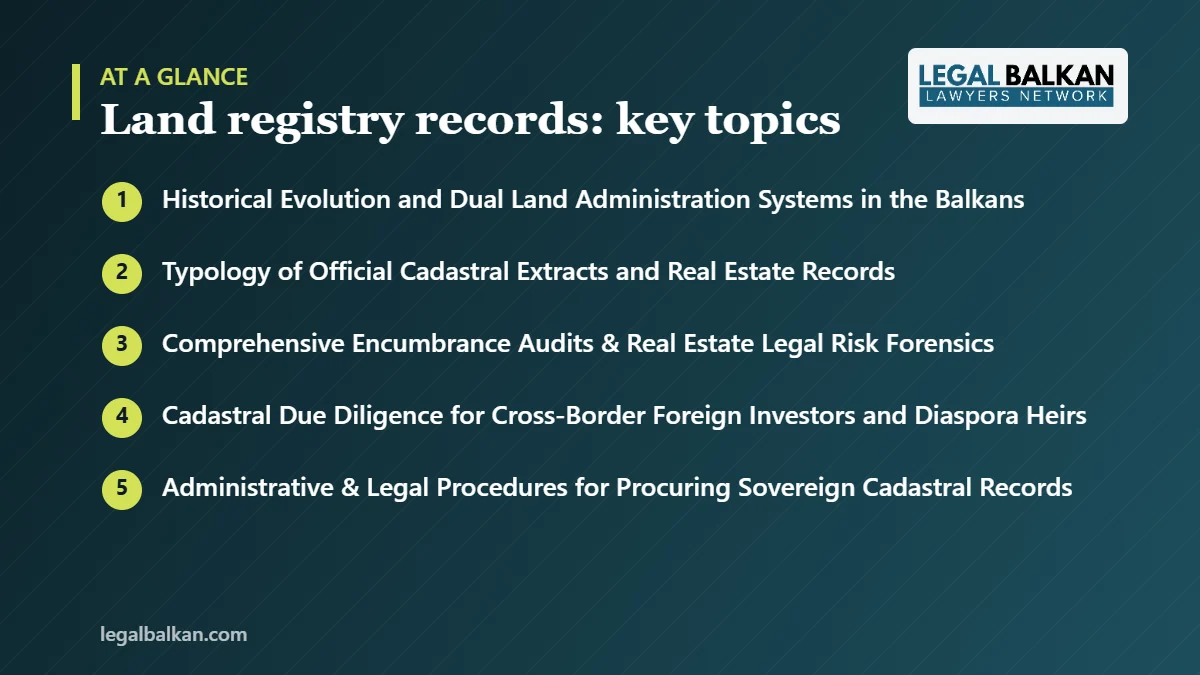
Typology of Official Cadastral Extracts and Real Estate Records
Securing the correct official documentation from foreign land registries requires identifying the precise legal extract corresponding to the client's transactional, litigation, or inheritance objectives:
1. Real Estate Title Certificate (List Nepokretnosti / Certifikatë Pronësie / Tapu Senedi)
The definitive sovereign document proving current legal ownership of immovable property. Across North Macedonia, Serbia, Montenegro, and Bosnia, the classic Real Estate Folio (*List nepokretnosti / ZK izvadak*) is structured into three standardized components:
- Sheet A (Posjedovnica / Popisni list): Detailed technical identification of the real estate parcel, including municipal cadastral district (*katastarska opština*), parcel number, land culture (arable land, forest, vineyard, urban construction plot), surface area in square meters or hectares, and registered structural buildings.
- Sheet B (Vlastovnica / Vlasnički list): Complete identity of registered legal owners, their national identification numbers (JMBG / NIPT / T.C. Kimlik), legal basis of acquisition (purchase contract, court probate decree, gift deed, privatization decision), and ownership modality (exclusive sole ownership / *1/1 svojina*, joint marital co-ownership / *zajednička svojina*, or fractional co-ownership quotas / *sussvojina 1/2, 1/4*).
- Sheet C (Teretovnica / Teretni list): Comprehensive inventory of registered encumbrances, third-party rights, and legal restrictions (*tereti i ograničenja*). This includes voluntary and judicial mortgages, bailiff enforcement execution orders, easements of way, life usufruct rights (*doživotno plodouživanje*), historical restitution notations, and unpermitted construction flags.
2. Historical Chain of Title Extract (Istorijat Promena na Parceli / Vërtetim Historik)
Standard cadastral extracts reflect only current title status. In inheritance disputes, restitution claims, or M&A forensic investigations, acquiring the Historical Chain of Title Extract is critical. This document tracks all proprietary modifications, transfers, subdivisions, and recorded rights affecting the parcel spanning past decades, revealing the exact legal transactions through which ancestral owners were divested of property.
3. Copy of the Cadastral Plan (Kopija Katastarskog Plana / Harta Kadastrale)
An official geodetic cartographic excerpt illustrating the precise geometric boundaries, spatial coordinates, neighboring parcel numbers, and building footprints as registered in the official state geodetic survey. In transactions involving high-value industrial or commercial plots, our team coordinates with licensed geodetic surveyors to execute on-site boundary verification (*omeđavanje / vënies e kufijve*) to reconcile map records with actual physical fencing.
4. Cadastral Parcel Identification Certificate (Uverenje o Identifikaciji Parcela)
Due to multiple post-war geodetic re-surveys and cadastre modernizations, historical parcel numbers from the Austro-Hungarian land books (*stari gruntovni broj*) or pre-war cadastral maps rarely match contemporary parcel numbers (*novi katastarski broj*). Obtaining an official Certificate of Identification from the municipal geodetic authority formally reconciles the historical parcel identity with the modern registry, an essential procedural prerequisite for resolving inheritance and estate disputes across the Balkans.
Comprehensive Encumbrance Audits & Real Estate Legal Risk Forensics
Acquiring real estate in the Balkans without a thorough, forensic encumbrance audit exposes purchasers to catastrophic financial loss. Encumbrances recorded in Sheet C or unrecorded latent legal risks demand rigorous scrutiny:
1. Voluntary and Judicial Mortgages (Hipoteka / Pengu Hipotekar / İpotek)
Investigating registered mortgages requires analyzing the underlying banking credit facility, promissory notes, principal loan amounts, default interest provisions, and the mortgage rank (*prvenstveni red*). Crucially, under the Mortgage Laws of Serbia, North Macedonia, and Montenegro, our attorneys verify whether the mortgage constitutes an Executive Out-of-Court Mortgage (Izvršna vansudska hipoteka), which grants the creditor bank statutory authority to sell the property at public auction without a court trial upon debtor default.
2. Judicial Notations and Pending Litigation Flags (Zabeležba Spora / Shënimi Gjyqësor)
A registered notation of dispute (*zabeležba spora*) alerts the public that the property is subject to active civil court litigation regarding ownership, boundary lines, or contract annulment. Under the doctrine of public faith, any purchaser who acquires real estate subject to a registered dispute notation is legally bound by the ultimate judicial judgment rendered against the seller. We conduct comprehensive docket searches across municipal and commercial courts to assess the procedural risks of pending claims.
3. Enforcement Execution Notations (Zabeležba Rešenja o Izvršenju)
When a property owner defaults on commercial debts, court-appointed public enforcement officers (*javni izvršitelji*) register an execution notation against the debtor's real estate. This notation legally freezes the property, barring any consensual sale or transfer. Our practice works closely with our specialized unit for debt collection and commercial receivables recovery to navigate or clear execution attachments.
4. Easements, Servitudes, and Life Usufruct Rights (Službenosti i Plodouživanje)
Real servitudes (*stvarne službenosti*—such as vehicular rights of way, pipeline easements, electrical transmission rights) and personal servitudes (*lične službenosti*—most notably life usufruct rights / *doživotno plodouživanje / intifa hakkı*) remain legally attached to the land regardless of ownership changes. A purchaser acquiring property encumbered by a life usufruct cannot physically occupy or utilize the residence until the usufructuary's death.
5. Unregistered Construction and Legalization Notations (Ozakonjenje / Legalizacija)
Millions of residential and commercial structures across the Western Balkans were constructed during the post-socialist transition without formal building and occupancy permits (*građevinska i upotrebna dozvola*). Cadastral records explicitly flag such properties: "Objekat izgrađen bez građevinske dozvole" (Building erected without building permit) or "Objekat u postupku ozakonjenja". Properties bearing unpermitted construction notations cannot be pledged for commercial mortgage loans and face potential administrative demolition orders unless fully formalized under national legalization statutes.
Cadastral Due Diligence for Cross-Border Foreign Investors and Diaspora Heirs
Foreign individuals and multinational corporate entities acquiring real estate in South-Eastern Europe must comply with strict statutory eligibility frameworks:
1. Statutory Reciprocity and Foreign Property Ownership Restrictions
Across the Western Balkans, foreign natural persons may acquire residential apartments and commercial buildings subject to the principle of diplomatic or factual reciprocity (*reciprocitet*) established between the investor's home state and the host nation:
- Agricultural Land Restrictions: In North Macedonia, Serbia, Bosnia and Herzegovina, and Montenegro, foreign natural persons and foreign-incorporated companies are legally prohibited from directly owning agricultural land (*poljoprivredno zemljište*). However, foreign investors routinely overcome this statutory barrier by incorporating a domestic commercial company (e.g., a Serbian DOO or North Macedonian DOOEL), which, as a domestic corporate citizen, enjoys full statutory authority to acquire agricultural and industrial acreage, as detailed in our guide to company establishment and corporate structuring across the Balkans.
- Turkey: Under Article 35 of Land Registry Law No. 2644, foreign citizens of designated permitted nations can acquire residential and commercial real estate up to 30 hectares, subject to clearance from military security and strategic defense zones.
2. Archival Tracing for Unprobated Generational Inheritances
Millions of diaspora descendants residing in Germany, Switzerland, the United States, Australia, and Turkey possess rightful inheritance claims to ancestral estates across South-Eastern Europe. However, because ancestral titles were never probated across successive generations, the land remains registered in the names of deceased grandparents or great-grandparents. LegalBalkan conducts forensic genealogical and cadastral title investigations, extracting historic birth, marriage, and death records through our specialized unit for obtaining documents from official institutions across the Balkans, enabling clients to reopen generational probate proceedings and formally register their lawful ownership quotas.
Administrative & Legal Procedures for Procuring Sovereign Cadastral Records
Procuring certified cadastral extracts from foreign land registries requires strict compliance with domestic administrative procedures and legal representation mandates:
1. Power of Attorney, Apostille & Sworn Court Translations
While public geodetic portals provide basic informational previews, obtaining certified, court-admissible title deeds (*zvanični izvod iz katastra sa suvim žigom / certifikatë pronësie zyrtare*) requires a formal administrative application. Foreign applicants must execute a specialized Power of Attorney (PoA) before a notary public in their home country, affixed with a Hague Apostille (under the 1961 Hague Convention) or diplomatic legalization through consular channels, as outlined in our advisory on consular authentication and apostille consultancy. The document is then formally translated into the local sovereign language by a licensed court-sworn translator (*ovlašćeni sudski prevodilac*).
2. Digital e-Katastar Portals vs. Physical In-Person Archival Searches
While Serbia (Geosrbija / e-Katastar) and North Macedonia (e-Katastar AREC) have established advanced digital geodetic portals, full digital access to confidential historical folios, underlying acquisition contracts (*osnov sticanja*), and subdivision maps is restricted to licensed attorneys, registered notaries, and authorized geodetic survey firms. In Albania (e-Albania / ASHK portal), Kosovo, Bosnia and Herzegovina, and Montenegro, physical municipal registry submissions and archival research remain mandatory for extracting historic title instruments and resolving administrative boundary discrepancies.
Comparative Statutory Framework for Land Registry & Cadastre Across the Balkans
The following authoritative comparative matrix outlines governing land registry and cadastre authorities, primary official title extracts, digital search platforms, foreign ownership restrictions, and administrative issuance timeframes across North Macedonia, Serbia, Albania, Kosovo, Bosnia and Herzegovina, Montenegro, and Turkey:
| Jurisdiction | Cadastral & Land Registry Authority | Primary Official Title Extract | Digital Geodetic Platform / Search Portal | Foreign Ownership Restrictions | Certified Issuance Timeline |
|---|---|---|---|---|---|
| North Macedonia | Agency for Real Estate Cadastre (Agencija za katastar na nedvižnosti - AREC / Katastar). | Immovable Property Folio (Imoten list / Изводот од катастарот на недвижности). | e-Katastar portal (e-kat.katastar.gov.mk); professional attorney access available. | Reciprocity applies for apartments/commercial; foreign direct ownership of agricultural land banned (domestic DOOEL allowed). | 1–3 business days via digital portal; 5–7 days for archival historical deeds. |
| Serbia | Republic Geodetic Authority (Republički geodetski zavod - RGZ / Službe za katastar nepokretnosti). | Real Estate Folio (List nepokretnosti - LN / e-Katastar izvod). | Geosrbija (geosrbija.rs) and RGZ e-Katastar digital public inspection service. | Reciprocity for residential/commercial property. Direct foreign ownership of agricultural land restricted; domestic DOO permitted. | 24–48 hours for electronic certified LN; 5–10 days for historical chain of title. |
| Albania | State Cadastre Agency (Agjencia Shtetërore e Kadastrës - ASHK / Zyrat Vendore ASHK). | Ownership Certificate (Certifikatë e Pronësisë mbi Pasurinë e Paluajtshme). | e-Albania government portal integrated with ASHK central cadastral database. | Foreigners can acquire apartments/commercial buildings. Agricultural land acquisition requires commercial company setup. | 5–10 business days via e-Albania digital application; longer for unregularized parcels. |
| Kosovo | Kosovo Cadastral Agency (Agjencia Kadastrale e Kosovës - AKK) & Municipal Cadastral Offices (ZKK). | Certificate on Rights to Immovable Property (Certifikata mbi të Drejtat e Pasurisë së Paluajtshme). | Kosovo Cadastral Land Information System (KCLIS / Gjeoportali Shtetëror). | Reciprocity applies. Foreign natural persons can acquire apartments; agricultural land restricted without local legal entity. | 3–5 business days through municipal cadastral offices; archival searches take 10–15 days. |
| Bosnia & Herzegovina | Dual System: Municipal Court Land Book (Gruntovnica) & Geodetic Administration (Katastar / FGU / RUGIPP). | Land Registry Extract (Zemljišnoknjižni izvadak - ZK) & Possession Sheet (Posjedovni list). | e-Grunt e-portal (e-grunt.pravosudje.ba) and entity geoportals (fgu.com.ba / rgzrs.org). | Strict reciprocity list published by Ministry of Justice. Corporate incorporation commonly used to circumvent restrictions. | 2–5 business days for municipal ZK extract; 7–14 days for dual harmonization checks. |
| Montenegro | Administration for State Property and Cadastre (Uprava za nekretnine Crne Gore - UZIN). | Real Estate Folio (List nepokretnosti - LN / Izvod iz katastra nepokretnosti). | e-Katastar Crne Gore public search portal (geoportal.co.me / katastar.me). | Foreigners can own apartments/villas freely; direct ownership of agricultural land over 5,000 m2 restricted. | 2–4 business days via regional cadastral offices (Podgorica, Budva, Kotor, Bar). |
| Turkey | General Directorate of Land Registry and Cadastre (Tapu ve Kadastro Genel Müdürlüğü - TKGM). | Official Title Deed (Tapu Senedi) & Cadastral Registry Record (Tapu Kaydı Belgesi). | Web-Tapu digital portal (webtapu.tkgm.gov.tr) and Parsel Sorgu spatial inquiry system. | Article 35 Tapu Law. Permitted countries list; 30-hectare national cap; military security clearance mandatory. | Same-day issuance via Web-Tapu for verified owners/proxies; 3–5 days for archival Ottoman defts. |
Frequently Asked Questions (FAQ): Balkan Land Registry & Cadastral Records
1. What is the difference between a Cadastre (Katastar) and a Land Book (Gruntovnica)?
The Cadastre (*Katastar*) historically records the technical and cartographic survey of land—parcel boundaries, surface areas, land categories, and physical structures for tax assessment purposes. The Land Book (*Gruntovnica / Zemljišna knjiga*), maintained by municipal courts, records legal ownership title, mortgages, and registered encumbrances based on the principle of public trust. While Serbia, North Macedonia, and Montenegro have unified these two registers into a single Real Estate Cadastre, Bosnia and Herzegovina still maintains a dual system requiring cross-verification of both offices.
2. Can a foreign citizen obtain official land registry records in the Balkans?
Yes. Real estate registers across the Balkans operate on the fundamental civil law principle of publicity (načelo javnosti). Anyone may inspect public parcel maps and request basic cadastral extracts. However, obtaining certified, sealed extracts containing private personal data (such as national ID numbers, purchase prices, or complete chain-of-title archives) requires demonstrating a legitimate legal interest or acting under a legalized Power of Attorney from a registered owner or interested party.
3. What does "Sheet C" (Teretovnica) in a Real Estate Folio indicate?
Sheet C (*Teretovnica / Teretni list*) is the encumbrance section of a real estate folio. It lists all third-party legal claims, registered mortgages, bank pledges, enforcement execution notations, rights of way, lifeterm usufruct rights, building permit irregularities, and pending court dispute notations. A property cannot be purchased safely without a clean Sheet C or a legally structured debt-clearance agreement.
4. How do I trace ancestral real estate if I only have pre-war family documents?
Ancestral property research requires historical parcel identification. Historical Austro-Hungarian land book folios or Ottoman tapu deeds reference obsolete parcel numbering systems. LegalBalkan conducts archival research in municipal historical archives, coordinating with licensed geodetic engineers to obtain an official Certificate of Identification (*Uverenje o identifikaciji parcela*), which legally matches historical parcels to contemporary cadastre entries.
5. Can foreign individuals directly purchase agricultural land in the Balkans?
In North Macedonia, Serbia, Bosnia and Herzegovina, and Montenegro, foreign natural persons are prohibited by law from directly acquiring agricultural land (*poljoprivredno zemljište*). However, foreign investors routinely circumvent this restriction by incorporating a domestic commercial company (such as a DOO in Serbia or DOOEL in North Macedonia), which, as a domestic legal entity, has full statutory authority to acquire agricultural acreage.
6. What is a "Zabeležba Spora" (Dispute Notation), and why is it dangerous?
A *Zabeležba spora* is an official notation registered in the cadastral folio indicating that the property is the subject of active civil court litigation regarding ownership title, boundaries, or contract invalidation. Under the principle of public faith, anyone who purchases property bearing a registered dispute notation is automatically bound by the final court judgment rendered against the seller, potentially losing both the property and purchase capital.
7. What does "Building constructed without a building permit" mean in a Balkan cadastral extract?
This notation indicates that the building or an extension was constructed without sovereign building and occupancy permits. While the property can often be registered, it carries significant legal risks: it cannot be used as collateral for bank mortgage financing, and it may be subject to future demolition orders unless formalized under national legalization statutes (*ozakonjenje / legalizacija*).
8. Do I need to travel to the Balkan country to extract official cadastral records?
No. By executing a Power of Attorney (PoA) before a notary public in your home country and affixing a Hague Apostille (or consular legalization), LegalBalkan's licensed attorneys can submit all administrative applications, conduct physical archival searches, inspect court land books, and obtain certified official documents on your behalf without your physical presence.
9. How does the Web-Tapu system work in Turkey for foreign property owners?
Turkey’s General Directorate of Land Registry and Cadastre (TKGM) operates the Web-Tapu digital portal (*webtapu.tkgm.gov.tr*). Foreign property owners and their authorized attorneys can inspect title deeds, review registered mortgages, pay cadastral fees, and initiate formal transfer appointments online. Certified title documents (*Tapu Kaydı Belgesi*) with official QR-code verification can be generated electronically within hours.
10. What is an Executive Out-of-Court Mortgage (Izvršna vansudska hipoteka)?
An executive out-of-court mortgage is a specialized mortgage agreement registered in Sheet C under which the property owner explicitly waives the right to a court trial upon loan default. If the debtor fails to satisfy the underlying debt, the creditor bank has the statutory power to order the public sale of the real estate directly through a public auction conducted by a licensed notary or bailiff, bypassing lengthy judicial litigation.
Retain LegalBalkan: Sovereign Land Registry Forensics & Real Estate Due Diligence
Real estate transactions and generational property investigations across South-Eastern Europe demand absolute cadastral clarity, institutional rigor, and assertive legal advocacy. Whether you are acquiring commercial development acreage, auditing loan collateral, resolving unrecorded property liens, or recovering ancestral inheritance estates, LegalBalkan delivers unparalleled real estate forensics across all seven regional jurisdictions.
For related cross-border property and corporate solutions, explore our practice areas: LegalBalkan Practice Areas & Cross-Border Legal Services, our specialized estate practice in Inheritance and Estate Disputes Across the Balkans, our corporate formation and investment advisory in Company Establishment & Corporate Services in the Balkans, our administrative document retrieval services in Obtaining Official Documents Across the Balkans, and our legalization practice in Consular Authentication and Apostille Consultancy.
Contact our central real estate and cadastral due diligence group to schedule a confidential title audit:
- Headquarters: Majakovski 7, Skopje, North Macedonia
- Direct WhatsApp / Client Telephone Intake: +389 70 678 670
- Confidential Legal Inquiries: info@legalbalkan.com
- Direct Contact Portal: LegalBalkan Contact & Case Evaluation
- Managing Partner: Osman Efe Eren, Attorney-at-Law
- Regional Operational Coverage: Skopje | Belgrade | Tirana | Sarajevo | Prishtina | Podgorica | Istanbul
Related Legal Guides
Have a question about your own case? Contact Legal Balkan for a confidential first assessment.