In an increasingly interconnected global economy, multinational corporations, private investors, and global citizens face intricate regulatory hurdles when presenting official documentation across sovereign borders. Whether executing foreign direct investment (FDI), establishing international corporate subsidiaries, engaging in cross-border civil litigation, or completing cross-border mergers and acquisitions (M&A), legal documents issued in one jurisdiction possess no intrinsic evidentiary value in another without formal authentication and legalization.
Navigating the cross-border administrative labyrinth requires high-level consular authentication and apostille consultancy. For parties operating within the Western Balkans—including North Macedonia, Serbia, Albania, Montenegro, and Bosnia and Herzegovina—the intersection of domestic civil codes, bilateral legal assistance treaties, and multilateral conventions demands absolute procedural precision.
At LegalBalkan (www.legalbalkan.com), we provide end-to-end strategic oversight and operational management for public and private document legalization. From statutory notarization and court-sworn translations to apostille certification and bilateral diplomatic mission endorsement, this guide details the exact legal architecture governing cross-border document authentication.
Table of Contents
1. Document Internationalization: Apostille vs. Consular Legalization
To determine the statutory path of document validation, international law divides jurisdictions into two categories: signatories to multilateral simplification conventions and non-signatory states requiring full bilateral chain legalization.
[ Document Originates ]
│
Is Destination Country a Member of the 1961 Hague Apostille Convention?
├── YES: Simplified Path (HCCH) ➔ Local Notarization ➔ Competent Authority Apostille ➔ [ Valid for Foreign Use ]
└── NO: Full Consular Chain ➔ Local Court ➔ Ministry of Justice ➔ MFA ➔ Destination Embassy ➔ [ Valid for Foreign Use ]
The 1961 Hague Apostille Convention Framework
The foundation of modern international document exchange is the Hague Convention of 5 October 1961 Abolishing the Requirement of Legalisation for Foreign Public Documents (HCCH 1961 Apostille Convention). Under this treaty, member states waive the requirement of traditional consular legalization, substituting it with a single standardized certification: the Apostille Certificate.
Issued directly by a domestic designated competent authority, the Apostille certifies:
- The authenticity of the signature on the underlying document;
- The capacity in which the signatory acted; and
- Where appropriate, the identity of any seal or stamp affixed to the document.
Traditional Consular Legalization: Multi-Tiered "Chain Authentication"
When a destination country is not a contracting party to the HCCH 1961 Convention (e.g., the United Arab Emirates, Qatar, Kuwait, Egypt, Vietnam, or China—prior to its recent accession), documents must undergo traditional consular chain legalization.
This rigorous multi-tier procedure mandates:
- Verification by domestic primary municipal/district courts;
- Authentication by the national Ministry of Justice;
- Legalization by the national Ministry of Foreign Affairs (MFA);
- Final consular endorsement by the diplomatic mission (Embassy or Consulate General) of the destination state accredited to the originating country.
EU Regulation 2016/1191 and Cross-Border European Recognition
Within the European Union, Regulation (EU) 2016/1191 abolishes apostille and legalization requirements for specific public documents (such as birth, marriage, civil status, and clean criminal record certificates) exchanged between EU Member States.
However, for candidate and neighboring jurisdictions across the Western Balkans interacting with EU Member States or third countries, standard bilateral agreements and the HCCH Apostille regime remain strictly compulsory.
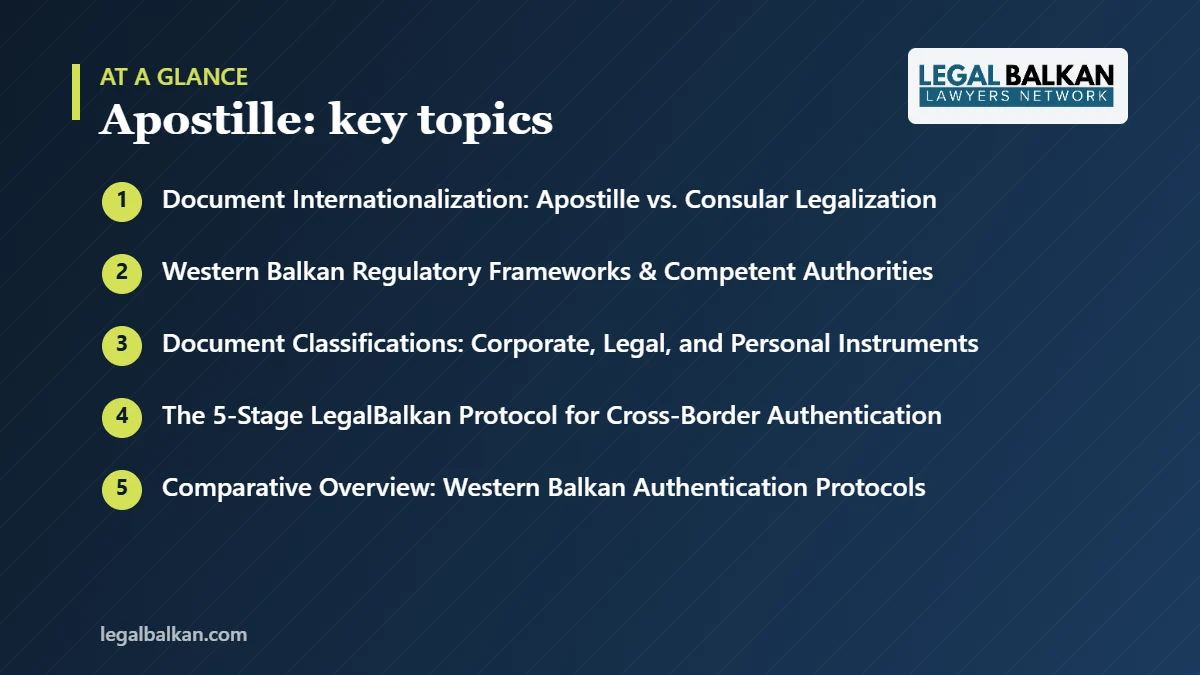
2. Western Balkan Regulatory Frameworks & Competent Authorities
Executing consular authentication in Southeastern Europe requires working with distinct administrative procedures across each national jurisdiction. LegalBalkan manages direct coordination across all regional public bodies.
| Country | Primary Competent Authorities for Apostille & Legalization |
|---|---|
| North Macedonia | Basic Courts (Основни судови), Ministry of Justice, and Ministry of Foreign Affairs |
| Serbia | Basic Courts (Osnovni sudovi), Ministry of Justice, and Ministry of Foreign Affairs |
| Albania | Ministry for Europe & Foreign Affairs and e-Albania Portal |
| Montenegro | Basic Courts (Osnovni sudovi), Ministry of Justice, and MFA Directorate for Consular Affairs |
| Bosnia & Herzegovina | Municipal/Basic Courts, Ministry of Justice of BiH, and Ministry of Foreign Affairs of BiH |
North Macedonia
In the Republic of North Macedonia, apostille certification and consular legalizations are governed by national law and bilateral agreements overseen by the Ministry of Justice and the Ministry of Foreign Affairs. Basic Courts hold primary authority for authenticating judicial and notarial acts, while consular authentications for non-Hague states proceed through the MFA Consular Department in Skopje.
Serbia
The Republic of Serbia maintains a decentralized court system under the supervision of the Ministry of Justice and the Ministry of Foreign Affairs. The Basic Courts (Osnovni sudovi) append the Apostille to public and notarized instruments, whereas documents intended for non-Hague destinations undergo mandatory verification at the MFA Legalization Department in Belgrade prior to consular submission.
Albania
The Republic of Albania has integrated its document authentication infrastructure through the e-Albania Governmental Portal and the Ministry for Europe and Foreign Affairs. Digital e-Apostilles and physical certifications are processed via synchronized administrative registries, aligning with the standards of the Council of Europe.
Montenegro
Under the administrative supervision of the Government of Montenegro, apostilles are affixed by the First-Instance Basic Courts across municipalities (Podgorica, Kotor, Bar, etc.), with diplomatic legalizations coordinated directly through the MFA Directorate for Consular Affairs.
Bosnia and Herzegovina
Due to its constitutional framework, Bosnia and Herzegovina distributes jurisdiction across the Federation of Bosnia and Herzegovina (FBiH), the Republika Srpska (RS), and the Brčko District. Primary court verifications are coordinated with the Ministry of Justice of BiH and finalized at the Ministry of Foreign Affairs of BiH in Sarajevo.
3. Document Classifications: Corporate, Legal, and Personal Instruments
Different types of documentation require tailored handling to ensure compliance with international legal standards and the requirements of destination institutions.
1. Corporate & Commercial Instruments
Cross-border corporate actions—such as international banking compliance under FATCA/CRS, foreign direct investment, opening foreign branches, or cross-border tenders—require authentication of:
- Certificates of Incorporation and Good Standing (issued by Central Registries / Chambers of Commerce);
- Articles of Association and Bylaws;
- Powers of Attorney (PoA) executed by corporate directors;
- Audited Financial Statements prepared under International Financial Reporting Standards (IFRS) as endorsed by the World Bank and OECD.
2. Civil, Vital, and Immigration Records
Individuals pursuing cross-border employment, international marriage, dual citizenship, or residency abroad must authenticate vital records:
- International and domestic Birth, Marriage, and Death Certificates;
- Certificates of No Criminal Conviction (Police Clearance Certificates);
- Affidavits of Single Status / Certificates of Celibacy;
- Proof of Financial Solvency and Tax Clearance.
3. Academic Credentials and Professional Qualifications
Cross-border employment accreditation and academic transfers require authentication of diplomas, transcripts, and certifications:
- Verification by national Ministries of Education;
- Legalization by primary courts or designated apostille authorities;
- Sworn certified translations into the target country's official language.
4. Judicial Decisions and Notarial Instruments
Enforcement of foreign arbitral awards (under the 1958 New York Convention - UNCITRAL) and court judgments requires authenticated copies of decisions, alongside notarized deeds, inheritance decisions, and sworn affidavits.
4. The 5-Stage LegalBalkan Protocol for Cross-Border Authentication
To guarantee 100% acceptance by foreign ministries, foreign registries, immigration authorities, and financial institutions, LegalBalkan employs a rigorous five-stage execution protocol:
Stage 1: Document Audit and Jurisdictional Assessment
Every engagement begins with an analysis of the originating document's format, issuing authority, and the exact legal requirements of the receiving foreign jurisdiction.
Stage 2: Sworn Certified Translation and Notarial Attestation
Translations must be performed by court-certified sworn translators registered with the Ministry of Justice and bound according to statutory requirements.
Stage 3: Apostille Issuance by Competent Judicial Authority
For HCCH 1961 Convention members, our legal team presents verified instruments before the competent Basic Court or Ministry for formal Apostille affixation.
Stage 4: Ministry of Justice and MFA Authentication
For non-Hague destinations, documents are submitted sequentially to the Ministry of Justice and the Ministry of Foreign Affairs Consular Department.
Stage 5: Consular Legalization by Foreign Diplomatic Missions
The finalized package is presented to the Embassy or Consulate General of the destination state with managed fee remittances and protocol compliance.
5. Comparative Overview: Western Balkan Authentication Protocols
| Jurisdiction | Apostille Body | Non-Hague Route | Processing Time | e-Apostille |
|---|---|---|---|---|
| North Macedonia | Basic Courts / Ministry of Justice | Court → MoJ → MFA → Foreign Embassy | 2 – 5 Days | Hybrid Verification |
| Serbia | Basic Courts (Osnovni sud) | Court → MoJ → MFA → Foreign Embassy | 3 – 7 Days | Physical Registry |
| Albania | Ministry for Europe & Foreign Affairs | Notary → MoJ → MFA → Foreign Embassy | 2 – 4 Days | e-Albania System |
| Montenegro | Basic Courts (Osnovni sud) | Court → MoJ → MFA → Foreign Embassy | 3 – 5 Days | Physical Registry |
| Bosnia & Herzegovina | Municipal / Basic Courts | Court → MoJ → MFA → Foreign Embassy | 4 – 8 Days | Physical Registry |
6. Critical Pitfalls in Cross-Border Legalization and Risk Mitigation
International document authentication carries zero tolerance for procedural error. A single clerical defect, improper translation sequence, or missing authentication seal can result in immediate rejection by foreign commercial registries, banks, or immigration ministries.
Key Risk Factors & LegalBalkan Protective Protocols:
- Temporal Expiration Limits: Registry records must not exceed 3 to 6-month validity windows set by destination authorities.
- Inverted Translation Sequences: Ensuring dual-apostille coverage so both the original instrument and the sworn translation are fully certified.
- Consular Jurisdiction Mismatch: Routing documentation through designated accredited regional consular hubs.
- Non-Compliant Notarization Clauses: Comprehensive pre-submission vetting by our legal compliance team.
7. Why Retain LegalBalkan for International Authentication Consultancy?
Cross-border legal validation demands reliable local execution and regional coverage. LegalBalkan provides a full-service bridge between local public administrations and international legal standards.
- Multi-Jurisdiction Regional Reach: Unified document management across North Macedonia, Serbia, Albania, Montenegro, and Bosnia and Herzegovina.
- Direct Access to Certified Translators and Notaries: An integrated network of court-sworn translators covering all major international languages.
- Institutional Security and Confidentiality: High-level data privacy protocols fully compliant with the European Union General Data Protection Regulation (GDPR - Regulation EU 2016/679).
- Time-Critical Expedited Processing: Direct, daily filing with judicial registries, foreign ministries, and accredited embassies.
8. Frequently Asked Questions (FAQ)
What is the primary difference between an Apostille and Consular Legalization?
An Apostille is an internationally standardized certificate issued under the 1961 Hague Convention that validates a document for use in all other member states through a single administrative step. Consular Legalization is a multi-tier authentication process required for non-Hague member states, involving sequential approvals by domestic courts, the Ministry of Justice, the Ministry of Foreign Affairs, and the destination country's embassy or consulate.
Does a document need to be translated before or after receiving an Apostille?
The required sequence depends on the destination country's legal regulations. In many jurisdictions, the original document must first receive an Apostille, followed by a certified sworn translation, and in some cases, a second Apostille is affixed to the sworn translator’s certification (a "Dual Apostille"). LegalBalkan determines the correct sequence for your target country before filing.
Are digital or electronic Apostilles (e-Apostilles) recognized across the Balkans?
Yes. Several regional states, notably Albania via the e-Albania system and partner states under the HCCH e-APP (Electronic Apostille Program), issue and verify electronic apostilles. However, traditional embossed seals and physical ribbons remain standard for many judicial and consular filings across Serbia, North Macedonia, Montenegro, and Bosnia and Herzegovina.
How long is an Apostille or Consular Legalization valid?
While the Apostille certificate itself does not have a formal expiration date under the Hague Convention, the underlying document frequently has strict statutory validity limits. Police clearance certificates, certificates of single status, and registry abstracts are typically valid for only 3 to 6 months from their date of issuance by foreign immigration or corporate authorities.
Can LegalBalkan authenticate corporate documents issued outside the Western Balkans?
Yes. LegalBalkan manages international cross-border legalizations through bilateral diplomatic missions and an international network of correspondent legal counsels, ensuring cross-border validity across the EU, the Middle East, the Americas, and Asia.Contact LegalBalkan Authentication Services
Related Legal Guides
Have a question about your own case? Contact Legal Balkan for a confidential first assessment.