Home » How We Work » 2. Consultation Step 2 of 6
Following a favorable preliminary intake in Phase 1: Request, the legal journey advances to strategic formulation. At Legal Balkan (www.legalbalkan.com), Phase 2: Consultation provides a rigorous, deep-dive analytical session where senior attorneys formulate tailored roadmaps, analyze comparative statutory mechanisms, anticipate cross-border risks, and provide clients with an authoritative written legal assessment.
Table of Contents
1. The Purpose and Value of a Deep Legal Consultation
Navigating sovereign legal institutions in Southeastern Europe requires far more than generic legal information; it requires concrete strategic alignment with statutory reality. A superficial approach to nationality or cross-border corporate law frequently results in protracted administrative deadlocks, unforeseen tax exposure, or outright rejections by ministries of interior and judicial registrars.
During Phase 2: Consultation, our senior counsel transitions your matter from preliminary inquiries into an exhaustive legal plan. We examine historical civil status records, corporate shareholding hierarchies, double taxation treaties, and private international law doctrines to identify the fastest, most cost-effective, and statutorily unassailable pathway to achieving your objectives.
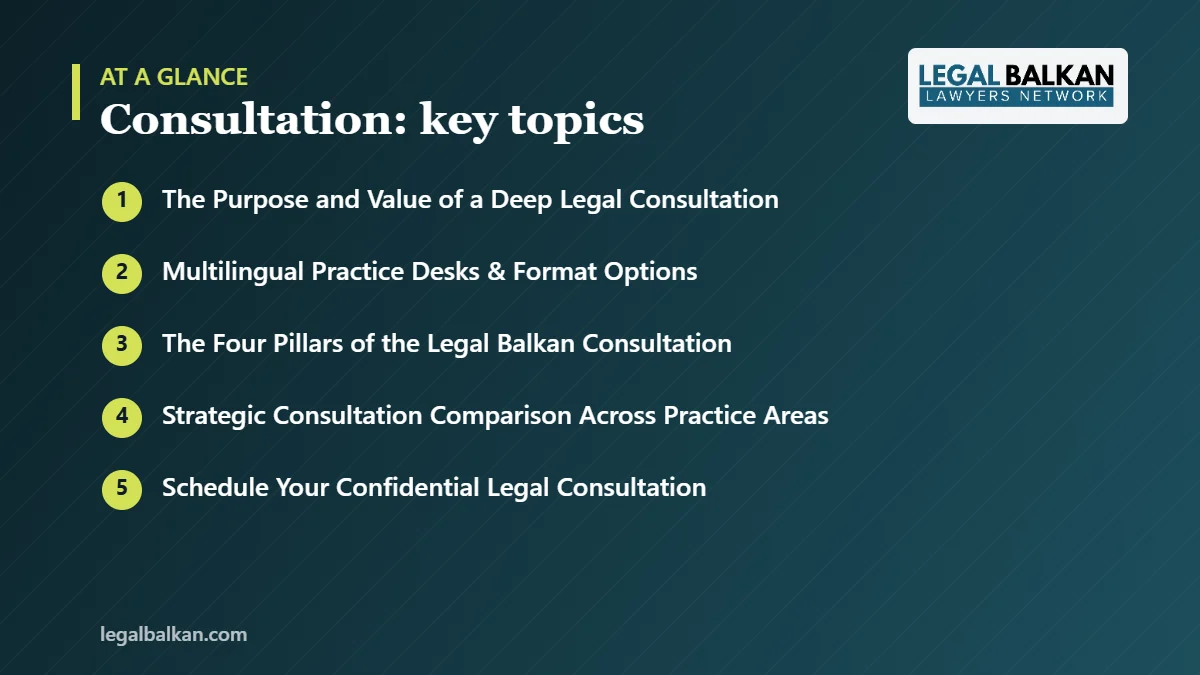
2. Multilingual Practice Desks & Format Options
Communication clarity is vital when analyzing nuanced legal concepts across multiple legal jurisdictions. Legal Balkan provides direct legal advisory through specialized multilingual desks:
- English Language Practice Desk: Serving international corporate entities, global family offices, and multinational investors.
- Turkish Language Practice Desk: Serving the extensive Balkan diaspora in Turkey seeking ancestral citizenship and commercial cross-border operations.
- Macedonian, Serbian & Albanian Regional Desks: Offering native legal counsel on statutory administrative procedures across Skopje, Belgrade, Tirana, and Pristina.
Consultation Delivery Formats:
- Virtual Strategic Sessions: 45-to-90 minute encrypted video consultations conducted via secure enterprise platforms, complete with screen-sharing document reviews and live legal mapping.
- In-Person Regional Conferences: Conducted at our central law offices in Skopje, Belgrade, Tirana, Pristina, or Istanbul, allowing clients to examine original historical ledgers and corporate documentation directly with managing partners.
3. The Four Pillars of the Legal Balkan Consultation
Pillar 1: Comprehensive Chronological Lineage & Commercial Audit
We perform an exhaustive factual audit tailored to the client's practice area:
- In Nationality & Lineage Matters: We trace the unbroken genealogical paper trail across generations. We analyze migration dates, historical naturalization decrees (Tabiiyet Kararnamesi), border transit records, and original Balkan municipal birth registrations (Izvod na rodeni / Izvod iz matične knjige rođenih).
- In Corporate & Commercial Expansions: We assess ownership structures (holding company vs. direct personal ownership), corporate governance requirements, share capital rules (e.g., 5,000 EUR in North Macedonia vs. 100 RSD in Serbia), and statutory manager residency conditions.
Pillar 2: Cross-Border Statutory Feasibility & Comparative Analysis
Where clients possess claims that could span multiple Balkan nations, our counsel conducts a comparative statutory evaluation:
- North Macedonia vs. Serbia: Evaluating whether an ancestral lineage claim is better structured under North Macedonia's Law on Citizenship (Articles 3–8 emigrant rights) or Serbia's Article 23 diaspora restitution regime.
- Dual Citizenship Protections: Verifying whether the destination country permits multiple nationalities without requiring release from original citizenship (e.g., full protection in North Macedonia, Serbia, Albania, and Kosovo vs. strict bilateral limitations in Bosnia and Herzegovina).
- Accession Horizon Privileges: Evaluating European Union candidate country timelines and mobility rights under the European Commission Enlargement Framework.
Pillar 3: Preemptive Risk Identification & Corrective Roadmap
Our attorneys identify potential evidentiary bottlenecks before they surface in ministry review queues:
- Name and Surname Discrepancies: Identifying phonetic distortions, omitted patronymic suffixes (-ov, -ski, -ic), or modified surnames resulting from destination country naming laws.
- The "01/07" Nominal Birthdate Problem: Flagging arbitrary default birthdates assigned in destination civil registers and outlining the mandatory judicial rectification lawsuit (Tashih Davası) required to harmonize records with authentic Balkan birth extracts.
- Security Clearance Preparation: Reviewing background profiles to ensure clean clearances during inter-agency vetting by national intelligence agencies (ANB, BIA, SHISH, AKI).
Pillar 4: Deliverable: The Strategic Legal Memorandum
Following the consultation, the client receives a formal written Strategic Legal Memorandum. This comprehensive executive brief details:
- Specific statutory articles governing the petition.
- An itemized checklist of primary evidence required.
- A projected procedural timeline divided into administrative phases.
- A transparent fee outline transitioning the case into Phase 3: Proposal and Agreement.
4. Strategic Consultation Comparison Across Practice Areas
| Practice Area | Consultation Core Focus | Primary Statutory Risk Analyzed | Key Deliverable |
|---|---|---|---|
| Citizenship by Descent | Unbroken genealogical paper trail & dual nationality | Generational cutoffs & name divergence | Lineage Viability Brief |
| Company Formation | Corporate structuring, taxation & bank compliance | Banking AML/KYC & director residency rules | Corporate Formation Blueprint |
| Archival Forensics | Historical registry locations & parish ledgers | Missing/damaged records & jurisdiction mapping | Archival Search Protocol |
| Civil Rectification | Court jurisdiction & evidentiary proof strategy | Substantive vs. clerical discrepancy rules | Litigation Action Plan |
5. Frequently Asked Questions About Phase 2: Consultation (FAQ)
1. How is the legal consultation conducted at Legal Balkan?
Consultations are conducted either through high-definition encrypted virtual conference platforms or in person at our central offices in Skopje, Belgrade, Tirana, Pristina, and Istanbul. Sessions last 45 to 90 minutes and are led by specialized Senior Managing Attorneys.
2. What languages are available for consultations?
Our practice operates multilingual desks offering direct, fluent legal advisory in English, Turkish, Macedonian, Serbian, and Albanian.
3. What deliverable does the client receive after Phase 2: Consultation?
Following the session, the client receives a comprehensive written Strategic Legal Memorandum detailing statutory avenues, required primary evidence, pre-identified risks, and estimated procedural timelines.
4. How does Legal Balkan assess dual citizenship restrictions during consultation?
Our attorneys evaluate comparative statutory rules across destination and origin states, determining whether dual citizenship is fully protected (e.g. North Macedonia under Articles 3-8, Serbia under Article 23, Albania, Kosovo) or restricted by bilateral conventions (e.g. Bosnia and Herzegovina).
5. Does the consultation fee get credited toward full engagement retainers?
Yes. When a client retains Legal Balkan for full representation in Phase 3: Proposal and Agreement, the initial consultation fee is credited in full against the formal engagement retainer.
Next Step in Our Process:
Following your consultation and strategy formulation, we proceed to formalizing representation under transparent terms.Explore Phase 3: Proposal and Agreement »
Schedule Your Confidential Legal Consultation
Gain absolute clarity on your cross-border legal options. Schedule a strategic consultation with our Senior Managing Attorneys across the Balkans and Turkey.Book a Strategic Legal Consultation
Related Legal Guides
Have a question about your own case? Contact Legal Balkan for a confidential first assessment.